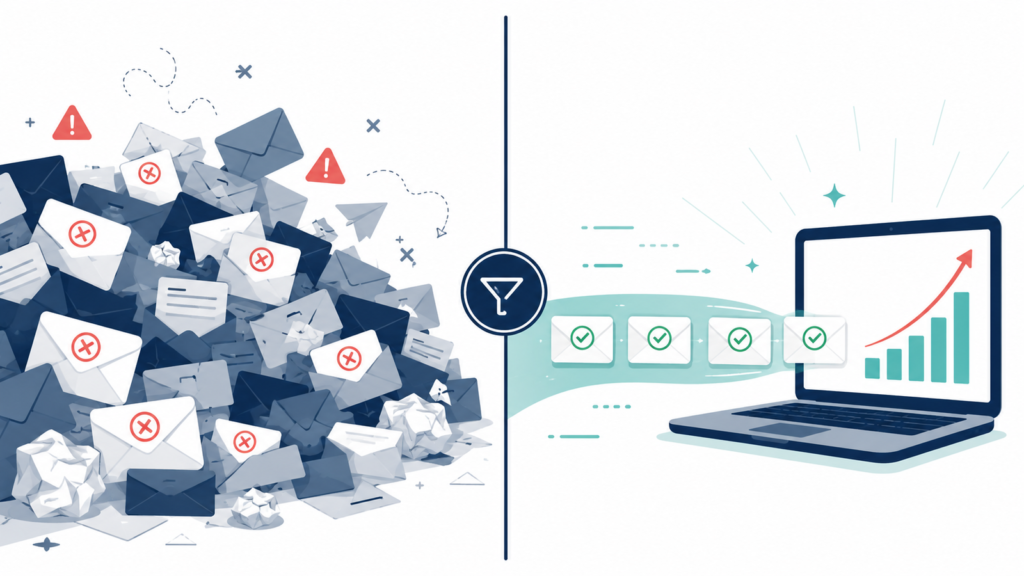
An email marketing list is a database of verified email addresses — organized by demographic, firmographic, or behavioral attributes — that businesses purchase or rent to run targeted outreach campaigns. When sourced from a reputable provider and used correctly, email marketing lists remain one of the most cost-effective channels for generating leads, nurturing prospects, and driving sales.
The question most marketers ask is not whether email lists work, but how to buy email lists that actually produce results rather than wasting budget on unresponsive contacts. The answer comes down to five factors: data quality, targeting precision, compliance, segmentation strategy, and provider reputation.
Is Buying Email Lists Legal?
This is the most common question in email marketing, and the answer is straightforward. In the United States, purchasing email lists for commercial marketing is legal under the CAN-SPAM Act. The law does not require prior opt-in consent from recipients. However, it does impose specific requirements on every commercial email you send.
Under CAN-SPAM, your emails must include accurate header information identifying who the message is from. The subject line must not be deceptive or misleading. The message must be clearly identified as an advertisement. You must include your valid physical business mailing address. And you must provide a clear, conspicuous opt-out mechanism that you honor within 10 business days.
Penalties for CAN-SPAM violations can reach up to $53,088 per email, so compliance is not something to take lightly. Working with a mailing list broker who understands these requirements ensures that the data you receive is sourced and structured for compliant use.
It is worth noting that laws differ internationally. Canada’s CASL (Canadian Anti-Spam Legislation) requires explicit opt-in consent, and the EU’s GDPR imposes similar restrictions. If your campaign targets recipients outside the U.S., consult with your legal team or work with a provider who offers compliance guidance for international mailing lists.
Types of Email Marketing Lists
Understanding the different categories of email lists helps you select the right one for your campaign objectives.
Consumer Email Lists
Consumer email lists contain the personal email addresses of individual people, typically combined with demographic data such as age, gender, income, location, homeownership status, and interests. These lists support B2C campaigns for industries like retail, home services, healthcare, financial services, and real estate.
Consumer email data is often sourced from survey responses, purchase transactions, subscription registrations, and publicly available records. At ProMarketing Leads, we source consumer email lists from our network of over 40,000 vetted data providers to ensure freshness and accuracy.
Business Email Lists (B2B)
Business email lists contain the professional email addresses of individuals identified by their company, job title, industry, and other firmographic attributes. These lists are essential for B2B marketing campaigns targeting decision-makers such as CEOs, CFOs, marketing directors, and IT managers.
Quality B2B email lists include verified direct email addresses — not generic info@ or sales@ addresses — which dramatically improves open and response rates. The best B2B email data is filtered by SIC or NAICS industry codes, company size, revenue, and geographic location.
Specialty Email Lists
For campaigns targeting highly specific audiences, specialty email lists offer the deepest level of precision. Examples include medical professional email lists, nurse email lists, investor email lists, real estate agent email lists, and new homeowner email lists. These niche lists command higher per-record pricing but typically produce significantly better conversion rates because the audience is pre-qualified.
How to Buy Email Lists That Convert: A 7-Step Process
Step 1: Define Your Ideal Recipient Profile
Before purchasing a single email address, define exactly who you want to reach. For consumer campaigns, this means specifying demographics like age range, income bracket, geographic area, homeownership status, and relevant interests or purchase behaviors. For B2B campaigns, define the industry, company size, revenue range, and specific job titles of your target contacts.
The more precisely you define your ideal recipient, the more effectively your list provider can build a targeted list — and the higher your conversion rates will be.
Step 2: Choose a Reputable List Provider
The quality of your email list depends entirely on the quality of your provider. Evaluate prospective providers on these criteria:
Data sourcing transparency. Where does the email data come from? The best providers use multiple verified sources — trade publication subscribers, conference attendees, purchase transaction records, professional license databases, and opt-in survey respondents. Be wary of providers who cannot explain their data sources.
Verification and hygiene processes. Does the provider verify email addresses for deliverability before selling them? Look for providers who run their data through email verification tools that check for invalid addresses, spam traps, role-based addresses, and disposable email domains.
Deliverability guarantees. Top-tier providers guarantee 85–95% email deliverability. If a provider offers no deliverability guarantee, consider that a red flag.
Compliance infrastructure. Your provider should be able to articulate how their data collection and usage practices comply with CAN-SPAM (and GDPR/CASL if applicable).
Customization depth. Can the provider filter by the specific attributes that matter to your campaign, or are they offering a one-size-fits-all database?
Step 3: Apply Targeting Filters
Once you have selected a provider, apply the targeting filters that narrow the list to your ideal audience. Common email list filters include:
For consumer emails: geography (ZIP code, state, city, radius), age, gender, household income, home value, interests and hobbies, purchase behavior, and life events (new homeowners, new movers, new parents).
For B2B emails: industry (SIC/NAICS code), company size, annual revenue, job title, job function, department, and geographic location.
Step 4: Request a Count and Sample
Before committing to a purchase, ask for a record count to understand the available universe. If the count is smaller than expected, you may need to broaden your criteria. If it is very large, consider testing a subset first.
Request sample records to preview data quality — check field completeness, email format consistency, and the presence of supplementary data points you need for personalization.
Step 5: Start with a Test Campaign
Never roll out a purchased email list at full scale without testing. Start with 3,000–5,000 records and send a well-crafted campaign. Measure open rates, click-through rates, bounce rates, unsubscribe rates, and conversions. These metrics tell you whether the list quality, your messaging, and your targeting are aligned.
Industry benchmarks for purchased email lists vary, but you should expect open rates in the 10–20% range for a cold list (compared to 25–40% for a house list of existing subscribers). Click-through rates of 1–3% on a purchased list indicate solid performance.
Step 6: Segment and Personalize
The single most effective tactic for improving conversion rates from purchased email lists is segmentation. Rather than sending the same message to everyone on the list, divide the list into segments based on relevant attributes and tailor your messaging to each group.
For example, if you purchased a consumer email list filtered by income and homeownership, you might create separate campaigns for high-income homeowners (promoting premium services) and middle-income renters (promoting value-oriented options). This level of personalization dramatically increases relevance and engagement.
Step 7: Build a Multichannel Follow-Up Sequence
Email alone produces results, but pairing email with other channels amplifies them significantly. Consider supplementing your email campaign with direct mail to the same audience (for a physical touchpoint), telemarketing follow-ups to warm leads who opened or clicked, and SMS messaging for time-sensitive offers.
A coordinated multichannel approach using the same audience data creates multiple touchpoints that reinforce your message and increase overall conversion rates.
5 Common Mistakes That Kill Email List ROI
Mistake 1: Buying the cheapest list available. Low-cost email lists are almost always low quality — filled with outdated addresses, recycled contacts, and spam traps. A cheap list that bounces at 30% and generates complaints is far more expensive in the long run than a quality list that delivers 90%+ deliverability.
Mistake 2: Sending to the entire list without segmentation. A one-size-fits-all blast to a purchased list will always underperform compared to segmented, personalized campaigns. Take the time to divide your list and tailor your messaging.
Mistake 3: Ignoring CAN-SPAM compliance. Every email must include your business address, clear sender identification, honest subject lines, and a functioning unsubscribe link. Failing to include any of these elements exposes you to penalties of up to $53,088 per email.
Mistake 4: Not cleaning your list before sending. Even freshly purchased email data benefits from a pre-send verification pass to remove any addresses that have become invalid between the provider’s last update and your send date.
Mistake 5: Giving up after one campaign. Email marketing to a new audience requires repetition and refinement. If your first campaign produces modest results, analyze what worked, adjust your targeting and messaging, and test again. Most successful email campaigns are built through iteration, not a single send.
Email List Pricing: What to Expect
Email marketing list pricing varies by several factors. List type matters — specialty and niche lists (such as medical email lists or investor email lists) cost more per record than broad consumer or business lists because of the additional verification and targeting involved.
Volume affects pricing as well. Most email lists are priced on a cost-per-thousand (CPM) basis, with per-record costs decreasing as order quantity increases. Targeting depth also plays a role — adding behavioral, financial, or professional filters beyond basic demographics typically carries a small surcharge.
Usage rights are another pricing variable. A one-time rental (single send) is less expensive than a multi-use license or outright data purchase. For businesses planning multiple campaigns to the same audience, purchasing the data often provides better value.
Frequently Asked Questions
Is it legal to buy email lists in the United States? Yes. The CAN-SPAM Act, which governs commercial email in the U.S., does not require prior opt-in consent from recipients. However, every email you send must comply with CAN-SPAM requirements: truthful sender information, honest subject lines, a physical business address, and a clear opt-out mechanism honored within 10 business days.
What is a good open rate for a purchased email list? For a well-targeted purchased list, expect open rates of 10–20% on an initial cold send. This compares to 25–40% for a house list of existing subscribers. Open rates improve with segmentation, personalization, and follow-up sequences.
How do I avoid spam traps when using a purchased email list? Work with a provider who actively verifies and cleans their data. Spam traps are email addresses created or repurposed to catch senders who use unverified lists. Running your purchased list through an email verification service before sending is an additional safeguard.
Can I use a purchased email list with Mailchimp, HubSpot, or Constant Contact? Most major email marketing platforms (including Mailchimp, HubSpot, and Constant Contact) prohibit the use of purchased lists in their terms of service. If you are sending to a purchased list, you will typically need to use a dedicated email sending platform or SMTP service designed for prospecting and cold outreach.
How often should I clean my email list? At minimum, clean your email list quarterly. Remove hard bounces immediately after each send, and run the full list through a verification service every 90 days to catch addresses that have become invalid.
What is the difference between renting and buying an email list? Renting an email list grants you one-time use for a specific campaign. The data provider typically sends the email on your behalf, and you do not receive the actual email addresses. Buying a list gives you the data file itself for repeated use. Your list broker can advise which option is best for your campaign strategy.