A direct mail list is a database of verified physical mailing addresses — along with associated demographic or firmographic data — used to deliver marketing materials through the postal mail system. Direct mail lists are the backbone of one of the oldest and still most effective forms of marketing, consistently delivering response rates that outperform most digital channels.
If you are planning a direct mail campaign, the quality of your mailing list is the single largest factor that determines success or failure. Industry experts estimate that the list accounts for roughly 40% of a direct mail campaign’s performance — more than the offer itself (30%) or the creative design (30%). Getting the list right is not optional; it is the foundation everything else is built on.
Why Direct Mail Still Works in 2026
In an age dominated by digital marketing, direct mail continues to deliver exceptional results for a straightforward reason: it cuts through the noise. The average person receives dozens of marketing emails daily but only a handful of physical mail pieces. This reduced competition for attention gives direct mail a significant advantage in open rates and engagement.
Direct mail also benefits from tactile engagement — people physically hold and interact with mail pieces, which creates stronger memory formation than scrolling past a digital ad. For businesses offering high-consideration products or services — financial services, home improvement, healthcare, and professional services — this tangible presence can meaningfully influence buying decisions.
When combined with digital channels like email marketing and telemarketing, direct mail becomes even more powerful as part of a coordinated multichannel strategy.
Types of Direct Mail Lists
Consumer Direct Mail Lists
Consumer mailing lists target individuals at their home addresses based on personal demographics. These lists are ideal for B2C businesses marketing directly to households. Common consumer targeting criteria include age, income, homeownership status, home value, family composition, interests, and purchase behavior.
Consumer direct mail lists are widely used by home services companies, retail brands, automotive dealerships, healthcare providers, financial services firms, real estate agents, and nonprofit organizations.
Business Direct Mail Lists
Business mailing lists target companies and their decision-makers at business addresses. These lists include firmographic data such as industry (SIC/NAICS codes), company size, revenue, and individual contact names with job titles.
Business direct mail is highly effective for B2B marketing because a personalized mail piece addressed to a specific decision-maker by name is far more likely to be opened than a generic business solicitation.
Occupant or Resident Lists
Occupant lists (also called saturation or resident lists) include every deliverable address in a geographic area without individual names or demographic data. They are the least expensive option and are useful for local businesses that want blanket coverage of a specific neighborhood, ZIP code, or carrier route. The USPS Every Door Direct Mail (EDDM) program utilizes this approach.
Specialty and Niche Direct Mail Lists
For campaigns targeting very specific audiences, specialty lists provide the highest level of precision. Examples include new homeowner lists (for home services and home goods), new mover lists (for local businesses), investor leads (for financial services), and medical professional lists (for pharmaceutical and healthcare marketing).
How to Buy Direct Mail Lists: Step by Step
Step 1: Set Your Campaign Objectives
Start by defining what success looks like. Are you generating leads? Driving store traffic? Booking appointments? Soliciting donations? Your objectives shape every subsequent decision — from the type of list you buy to the targeting criteria you apply.
Step 2: Identify Your Target Audience
Your ideal audience determines whether you need a consumer list, business list, or specialty list. Define the demographic, geographic, and behavioral characteristics of the people most likely to respond to your offer.
If you are unsure how to define your audience, a mailing list broker can help. Experienced brokers have worked across thousands of campaigns and can recommend targeting strategies based on what has performed well for similar businesses and offers.
Step 3: Select Your Targeting Filters
Once you know who you want to reach, apply the specific data selects that narrow the universe to your ideal prospects.
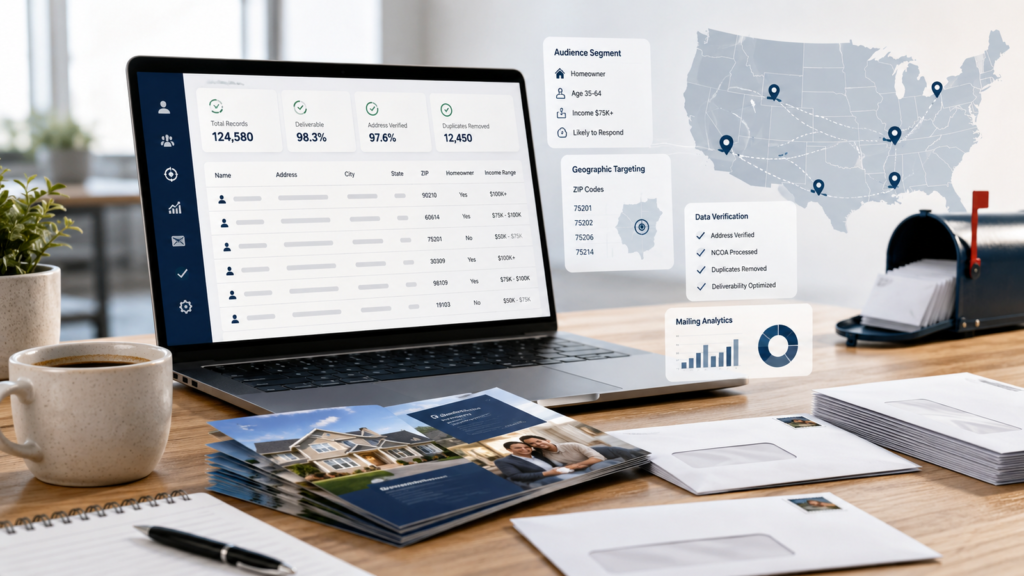
Geographic filters determine where your mail will be delivered — by state, county, city, ZIP code, carrier route, or radius around a location. For local businesses, tight geographic targeting ensures you are only paying for addresses within your service area.
Demographic or firmographic filters determine who within that geography receives your piece. For consumer campaigns, these include age, income, home value, and lifestyle attributes. For business campaigns, these include industry, company size, and job title.
Behavioral and life-event filters add another layer of precision. Targeting consumers who have recently purchased a home, recently moved to the area, recently made a large purchase, or recently experienced another qualifying life event can dramatically increase response rates because your offer reaches them at a moment of need.
Step 4: Evaluate Data Quality
Data quality is the difference between a 3% response rate and a 0.5% response rate. Here is what to check:
NCOA processing. The National Change of Address database, maintained by the USPS, tracks address changes filed in the past 48 months. Any reputable direct mail list provider processes their data through NCOA to eliminate addresses that are no longer valid.
CASS certification. The Coding Accuracy Support System ensures that addresses are standardized and properly formatted for USPS processing. CASS-certified addresses reduce undeliverable mail and may qualify your mailing for lower postage rates.
DPV (Delivery Point Validation). This USPS process confirms that a specific address is actually deliverable — that it exists and can receive mail. DPV-validated addresses produce the highest deliverability rates.
Data recency. Ask when the list was last updated. Monthly data refreshes are the industry gold standard. Avoid lists that have not been updated in 6 months or longer, as address data degrades rapidly.
Step 5: Determine Your Quantity and Budget
Direct mail costs include the list, printing, postage, and any creative or fulfillment services. The list typically represents the smallest portion of total campaign cost but has the largest impact on results.
For a first-time campaign, start with a test quantity of 2,000–5,000 pieces to validate your list, offer, and creative before scaling up. Track response rates meticulously during the test so you can project ROI for the full rollout.
Step 6: Order and Receive Your List
Once you have finalized your targeting and quantity, your list provider will deliver the data in a format compatible with your mailing house or print-and-mail vendor. Standard formats include CSV, Excel, or tab-delimited files. The file will include the recipient’s name, address, and any additional fields you selected.
Many full-service providers, including ProMarketing Leads, can also coordinate directly with your mailing house to ensure the list is formatted correctly for the USPS presort process, which qualifies your mailing for reduced postage rates.
Direct Mail List Pricing Explained
Direct mail list pricing is typically structured on a cost-per-thousand (CPM) basis. Several factors affect the price:
Base CPM covers the basic list rental or purchase with standard geographic and demographic selects. This is the starting point.
Select surcharges apply when you add specialized filters beyond the basics. Behavioral selects (purchase history, lifestyle data) and life-event selects (new homeowners, new movers) often carry a small additional per-thousand surcharge.
Usage rights affect cost. A one-time rental (most common for direct mail) gives you the right to mail the list once for a specific campaign. Multi-use rights or outright purchase of the data costs more but may be more economical for businesses that mail frequently.
Minimum order quantities vary by provider but are typically in the range of 1,000–5,000 records.
Maximizing Response Rates from Your Direct Mail List
Having the right list is the foundation, but how you use it also matters. Here are proven strategies for getting the best results:
Personalize everything. Use the recipient’s name, and tailor your message to their specific demographics or situation when possible. A mail piece addressed to “John Smith” that references his neighborhood or recent home purchase will outperform one addressed to “Current Resident.”
Match your offer to your audience. The targeting precision of your list should be reflected in your creative and offer. If you are mailing to high-income homeowners, your offer and design should reflect that audience’s expectations.
Test variables systematically. Test one variable at a time — list segment, offer, headline, format, or call to action — so you can isolate what is driving results.
Follow up across channels. Pair your direct mail with email follow-ups and telemarketing calls to create a multi-touch sequence. Multichannel campaigns consistently outperform single-channel efforts.
Track and measure. Use unique phone numbers, URLs, QR codes, or promotional codes for each mail segment so you can accurately attribute responses back to specific list segments and offers.
Frequently Asked Questions
What is the average response rate for direct mail? Industry averages vary by list type and offer, but response rates for well-targeted direct mail campaigns typically range from 2–5% for prospect lists and 5–9% for house lists (existing customers). These rates significantly exceed email marketing averages.
Should I rent or buy my direct mail list? For most campaigns, renting a list (one-time use) is the more cost-effective option. Buying is better if you plan to mail the same audience multiple times per year. Your list broker can advise based on your specific campaign frequency and budget.
How long does it take to get a direct mail list? Most list orders can be fulfilled within 24–48 hours of receiving your targeting specifications and payment. Rush orders may be available for time-sensitive campaigns.
Can I use a direct mail list for email marketing too? Not typically from the same rental agreement — direct mail lists and email marketing lists are usually licensed separately due to different compliance requirements. However, many list brokers can source both postal and email data for the same audience, allowing you to coordinate multichannel campaigns.
How do I know if my direct mail list is working? Track response rates by list segment using unique identifiers (tracking phone numbers, personalized URLs, promo codes). Compare cost per acquisition across segments to determine which targeting criteria produce the best ROI.
What happens if addresses on my list are undeliverable? Reputable list providers process data through NCOA, CASS, and DPV to minimize undeliverables. Many providers also offer deliverability guarantees — typically 93–98% for postal data. If your undeliverable rate exceeds the guarantee, you may be entitled to replacement records or a credit.
Start Your Direct Mail Campaign with the Right List
The success of every direct mail campaign begins with the data behind it. At ProMarketing Leads, our team of list experts will work with you one-on-one to identify the perfect audience, apply the right targeting filters, and deliver a verified, NCOA-processed mailing list that maximizes your campaign’s response rates and ROI.
Contact us today for a free consultation and custom quote. Call (866) 397-2772 to get started.