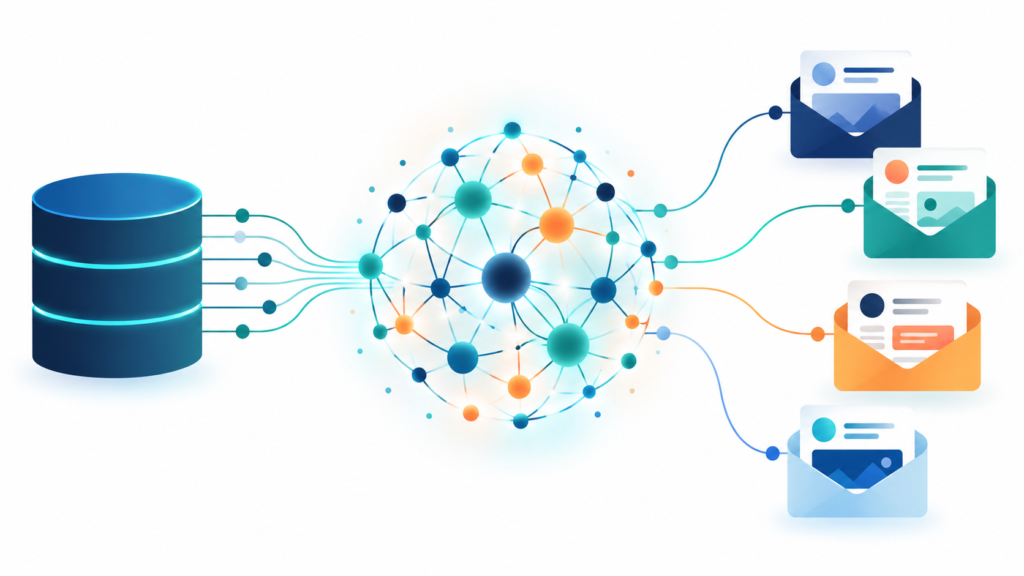
AI is no longer an experiment in direct marketing. Lob’s 2026 State of Direct Mail report found that 99% of marketing and operations leaders use AI or automation in their programs, and 96% say personalization lifts results, up sharply from 84% the year before. The same technology is reshaping email marketing, from subject line testing to send-time optimization.
But there is a catch that gets lost in the hype: AI amplifies the data you give it. Feed a model an outdated, thin, or inaccurate list and it will confidently personalize the wrong message to the wrong person at scale. This article covers where AI is making a real difference in direct mail and email, and why list quality matters more than ever.
1. Predictive Audience Modeling
AI models can analyze your best customers and find the characteristics they share: age bands, home value, income, interests, purchase behavior, and life stage. Those patterns are then used to score and select prospects from a larger consumer or business mailing list, often called lookalike or propensity modeling.
Why data matters: A model can only find patterns in fields that exist. The more demographic, firmographic, and interest data your list carries, the sharper the model. This is where data enrichment pays off.
2. One-to-One Personalization at Print Scale
Variable data printing has existed for years. AI makes it practical to generate and match many versions of copy, imagery, and offers to individual recipients. A home services postcard can show a different headline for a new homeowner than for a 20-year resident, and a different offer for a higher-value home.
The payoff is well documented. Focus Digital’s 2026 study found that adding a recipient’s name lifted direct mail response by 33%, and full personalization using name, offer relevance, and behavioral data produced a 135% lift over generic mail. Lob’s consumer research found that irrelevance is the number one reason mail fails.
3. Send-Time and Trigger Optimization
AI helps decide when to reach each person, not just what to say:
- Email send-time optimization schedules messages for the hour each recipient is most likely to engage.
- Triggered mail sends a physical piece automatically when a behavior or life event occurs, such as a move, a lease nearing expiration, or an abandoned quote.
- Cadence optimization adjusts how often each contact hears from you across mail, email, and phone to reduce fatigue.
Life-event data such as new homeowners, new movers, and vehicle lease timing is the fuel for trigger programs.
4. Faster Creative Testing
Generative AI can produce dozens of subject lines, headlines, and offer variations in minutes. Marketers can test more ideas, faster, and retire losers sooner. The discipline that still matters is testing one variable at a time and holding creative to a clear brand and compliance standard.
Guardrail: Every AI-generated claim needs human review. The FTC holds advertisers responsible for truthful, substantiated claims no matter who, or what, wrote the copy. Health and financial claims deserve extra scrutiny.
5. Better Attribution and Measurement
Direct mail has always been harder to attribute than digital. AI-assisted matchback and multi-touch models connect mail drops, email engagement, website visits, and sales to estimate each channel’s contribution. That makes it easier to prove what our direct mail KPIs guide recommends measuring: response, CPA, and ROI by segment.
Where AI Meets Email Specifically
- Subject line and preview text generation with automated A/B testing.
- Dynamic content blocks that change by segment, location, or behavior.
- Engagement scoring that identifies contacts ready for a sales call or a direct mail follow-up.
- List hygiene assistance that flags risky addresses before a send.
One caution for purchased lists: AI cannot fix a sending reputation damaged by bad data. Verify addresses and follow CAN-SPAM on every message.
Why List Data Quality Decides AI Results
Every AI capability above depends on the same foundation: accurate, current, well-structured data.
Accuracy. A model trained on addresses where 12% of people have moved will learn from noise. Clean data through NCOA, CASS, and DPV processing first.
Depth. Personalization needs something to personalize on. Lists with demographic, lifestyle, and life-event selects give AI more to work with than name-and-address files.
Reachability. Multichannel AI programs need email and phone data alongside postal addresses. A cell phone append or email append fills the gaps.
Compliance. AI does not change consent rules. SMS and autodialed calls still require prior express written consent, and new TCPA revocation rules apply to AI-driven programs too. Avoid using sensitive attributes such as health or ethnicity in ways that could discriminate or violate state privacy laws.
What AI Will Not Do for You
- It will not make a weak offer strong.
- It will not fix a list full of outdated or unverified contacts.
- It will not replace strategy, brand judgment, or compliance review.
- It will not create consent where none exists.
Frequently Asked Questions
How is AI used in direct mail marketing?
AI is used for predictive audience modeling, one-to-one personalization with variable data printing, triggered mail based on behavior or life events, faster creative testing, and multichannel attribution. Lob’s 2026 report found 99% of direct mail leaders use AI or automation.
Does personalization really improve direct mail response?
Yes. Focus Digital’s 2026 study found that adding a recipient’s name lifted response by 33% and full personalization produced a 135% lift over generic mail.
Can AI fix a bad mailing list?
No. AI amplifies the data it is given. Outdated or inaccurate records lead to confident personalization of the wrong message. Clean and enrich list data before using AI-driven targeting.
Do TCPA and CAN-SPAM rules apply to AI-driven campaigns?
Yes. AI does not change consent or disclosure requirements. Email must follow CAN-SPAM, and SMS and autodialed calls still require prior express written consent under the TCPA.
What data helps AI targeting the most?
Accurate contact data plus rich selects: demographics, household income, homeownership, interests, purchase behavior, and life events such as moves or new home purchases.
Give Your AI Better Data
At ProMarketing Leads, we supply the clean, deep, multichannel list data that AI-driven campaigns need, from verified direct mail lists to email and phone data for the same audience.
Contact us today for a free consultation. Call (866) 397-2772 to speak with a list expert.