

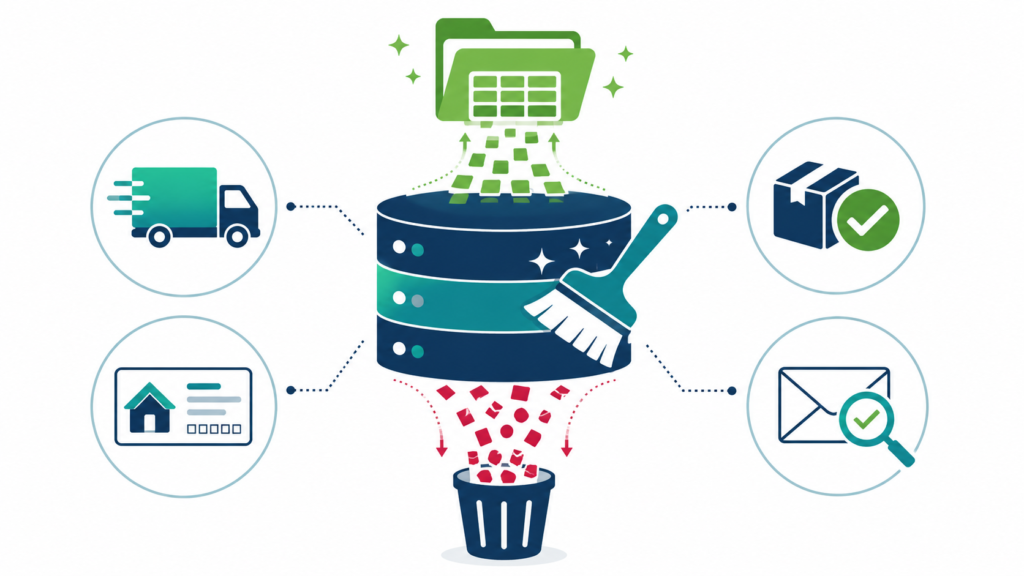
Mailing list hygiene is the process of verifying, correcting, and updating your contact data to remove inaccurate, outdated, and undeliverable records before sending a campaign. Whether you are working with direct mail lists, email marketing lists, or telemarketing lists, list hygiene is what separates a high-performing campaign from an expensive waste of budget.
The math is straightforward. An uncleaned mailing list that is 12 months old typically has a deliverability rate of 85-90%, meaning 10-15% of every dollar you spend on printing and postage goes to addresses that will never receive your piece. For a 50,000-piece direct mail campaign at $1.50 per piece, that is $7,500 to $11,250 in pure waste. Proper list hygiene eliminates the vast majority of this waste, pushing deliverability rates to 95-98%.
Why Marketing Data Degrades
Marketing data is not static. It decays continuously from the moment it is compiled, and the rate of decay varies by data type.
Postal addresses change as people move. The USPS processes approximately 35-40 million address changes annually through its National Change of Address system. That means roughly 12% of the U.S. population changes their mailing address in any given year. A list that is not updated regularly accumulates undeliverable addresses at a predictable rate.
Business contact data decays even faster. Industry estimates indicate that approximately 30% of B2B data becomes inaccurate within a single year due to job changes, promotions, company relocations, and business closures. A business mailing list that was accurate in January could have nearly one in three records outdated by December.
Email addresses become invalid as people change jobs (losing corporate email access), abandon personal accounts, or switch providers. Email decay is estimated at 20-25% per year for B2B addresses and 15-20% for consumer addresses.
Phone numbers are reassigned by carriers as subscribers disconnect or switch providers. The FCC estimates that approximately 100,000 phone numbers are reassigned daily in the United States. For SMS marketing and telemarketing, sending to a reassigned number means reaching someone who never consented to your messages — creating TCPA liability.
Postal Data Hygiene: NCOA, CASS, and DPV
For direct mail campaigns, postal data hygiene follows a standardized three-step process using USPS-maintained systems. Each step serves a distinct purpose, and all three should be run in sequence before any mailing.
Step 1: CASS Certification (Coding Accuracy Support System)
CASS is the first step in postal hygiene. It standardizes and corrects your addresses to USPS-preferred formatting.
What CASS does: Standardizes street suffix abbreviations (Street to ST, Avenue to AVE). Corrects misspelled street names and city names. Adds or corrects ZIP+4 codes. Adds carrier route codes. Corrects secondary unit designators (Apartment, Suite, Unit). Flags addresses that cannot be standardized to a valid USPS format.
Why it matters: CASS certification is required by the USPS for all presorted Marketing Mail. Without it, your mailing does not qualify for presort postage discounts — which can save $0.05-$0.10 per piece compared to single-piece rates. On a 50,000-piece mailing, that is $2,500-$5,000 in postage savings.
CASS answers the question: “Is this address correctly formatted for USPS delivery?”
Step 2: NCOA Processing (National Change of Address)
NCOA is the critical step that catches people who have moved. It compares your mailing list against the USPS NCOALink database, which contains every change of address filed with the Postal Service in the past 48 months.
What NCOA does: Identifies records where the individual or business has filed a change of address. Returns the new, updated address so your mail follows them to their current location. Flags records where no forwarding address is available (the person moved but did not file a change of address with USPS).
Why it matters: NCOA processing is required by the USPS under the Move Update standard. Any Marketing Mail dropped more than 95 days after the last NCOA processing incurs a penalty of $0.08 per piece for non-compliance. Beyond the penalty, unprocessed lists generate undeliverable mail — pieces that are either returned, forwarded at your expense, or simply discarded.
NCOA answers the question: “Does this person still live or work at this address?”
Step 3: DPV Validation (Delivery Point Validation)
DPV is the final verification step. While CASS confirms an address is formatted correctly and NCOA confirms the recipient has not moved, DPV confirms that the specific address actually exists and the USPS currently delivers mail to it.
What DPV does: Confirms that a specific address (not just a range of addresses on a street, but the exact house or apartment number) is a real, deliverable location in the USPS system. Flags addresses that are formatted correctly but do not correspond to an actual delivery point — such as vacant lots, demolished buildings, or addresses that have never received mail.
Why it matters: DPV catches addresses that pass CASS formatting checks but are not actually deliverable. This is the highest level of postal address verification available.
DPV answers the question: “Can the USPS actually deliver mail to this specific address right now?”
The Combined Result
Running all three steps in sequence — CASS, then NCOA, then DPV — produces the cleanest possible postal mailing list. Industry benchmarks from professional mail processors show that this three-step process achieves approximately 98.5% deliverability on a properly maintained list. For comparison, an unverified list of 12-month-old data typically runs 85-90% deliverable.
Email Data Hygiene
Email list hygiene is equally important but uses different tools. For email marketing lists, the hygiene process involves running your email addresses through a verification service that checks for:
Invalid addresses. Emails with syntax errors, nonexistent domains, or mailboxes that no longer exist. These generate hard bounces that damage your sender reputation.
Spam traps. Email addresses created or repurposed by ISPs and anti-spam organizations to catch senders who use unverified lists. Hitting a spam trap can result in your sending domain being blacklisted.
Role-based addresses. Generic addresses like info@, sales@, admin@, and support@ that are not tied to an individual. These often have higher complaint rates and lower engagement.
Disposable email addresses. Temporary addresses from services like Guerrilla Mail or Mailinator that are used once and then abandoned.
Catch-all domains. Domains configured to accept all incoming email regardless of the specific address — making it impossible to verify whether a particular mailbox exists.
Clean email lists achieve deliverability rates of 85-95%, compared to 70-80% for unverified lists. More importantly, clean lists produce dramatically fewer spam complaints and bounces, which protects your sender reputation and improves inbox placement for future campaigns.
Phone and SMS Data Hygiene
For telemarketing and SMS marketing, phone data hygiene involves:
Active status verification. Confirming that a phone number is currently active and assigned to a subscriber. Disconnected or inactive numbers waste calling time and SMS credits.
Line type identification. Determining whether a number is a mobile phone, landline, or VoIP line. This matters because SMS can only be delivered to mobile numbers, and certain TCPA provisions apply differently to mobile vs. landline calls.
Reassignment detection. Identifying numbers that have been reassigned to a new subscriber since the data was collected. Sending marketing messages to a reassigned number means contacting someone who never consented — a per-message TCPA violation.
DNC registry scrubbing. Comparing your call list against the National Do Not Call Registry and any applicable state DNC registries. DNC data must be refreshed at least every 31 days.
If you have an existing customer database that lacks phone numbers, a phone append service can match your records against phone databases to add verified numbers. Phone appending typically achieves a 30-60% match rate, depending on the quality and recency of your existing data.
How Often Should You Clean Your List?
The ideal hygiene frequency depends on the data type and how actively you use it.
Postal data: Process through NCOA at minimum every 90 days. The USPS requires NCOA processing within 95 days of mail date for Marketing Mail to avoid Move Update penalties. If you mail monthly or more frequently, process NCOA before each mailing. Run CASS and DPV every time you prepare a mailing file.
Email data: Verify before every campaign if you are mailing to a purchased or rented list. For house lists, quarterly verification is the industry standard. Remove hard bounces immediately after every send — do not wait for the next cleaning cycle.
Phone data: Scrub against the DNC registry at least every 31 days. Run active status and line type verification before every campaign, especially for SMS lists where TCPA compliance is at stake.
B2B data: Verify job titles, email addresses, and phone numbers monthly if possible. At minimum, clean B2B data quarterly to account for the 30% annual decay rate in business contact information.
Additional Hygiene Processes
Deduplication
Merge/purge processing identifies and removes duplicate records in your list — preventing the same person from receiving multiple copies of the same mail piece. Duplicates waste budget and annoy recipients. Deduplication should be run against your entire database before every campaign, and also when merging data from multiple sources (CRM exports, purchased lists, event registrations).
Deceased Suppression
Deceased suppression compares your list against death records to remove individuals who have passed away. Mailing to deceased individuals is not only a waste of budget but can cause distress to family members and damage your brand reputation. Deceased suppression files are typically updated monthly.
Prison Suppression
For certain campaigns — particularly financial services and insurance — prison suppression removes addresses associated with incarcerated individuals who cannot act on your offer.
Vacancy and Seasonal Address Flags
USPS vacancy data identifies addresses that have been vacant for 90+ days. Seasonal address flags identify addresses associated with snowbird patterns or second homes, helping you time mailings to when the recipient is most likely present.
The Cost of Not Cleaning Your List
List hygiene has a direct, measurable cost — but the cost of not cleaning is always higher.
Wasted postage and printing. At $1.50 per piece, 10% undeliverable mail on a 50,000-piece campaign wastes $7,500. Clean the list for a fraction of that cost and redirect the savings into reaching additional qualified prospects.
USPS Move Update penalties. Non-compliance with Move Update requirements costs $0.08 per piece — $4,000 on a 50,000-piece mailing — on top of the wasted postage on undeliverable pieces.
Damaged sender reputation (email). High bounce rates and spam complaints from dirty email lists damage your domain’s sender reputation, leading to lower inbox placement rates on all future campaigns — including campaigns to your clean, opted-in house list.
TCPA liability (phone/SMS). Sending marketing texts or calls to reassigned numbers or DNC-listed numbers creates per-message liability of $500-$1,500 under the TCPA.
Frequently Asked Questions
What is mailing list hygiene?
Mailing list hygiene is the process of verifying, correcting, and updating contact data to remove inaccurate, outdated, and undeliverable records. For postal data, it involves NCOA, CASS, and DPV processing. For email, it involves address verification against invalid, spam trap, and disposable addresses. For phone data, it involves active status verification and DNC registry scrubbing.
How often should I clean my mailing list?
Postal data should be NCOA-processed at minimum every 90 days (the USPS requires it within 95 days of mail date). Email lists should be verified before every campaign to purchased lists and quarterly for house lists. Phone data should be DNC-scrubbed at least every 31 days.
What is the difference between NCOA, CASS, and DPV?
CASS standardizes addresses to USPS formatting and adds ZIP+4 codes. NCOA updates addresses for people who have filed a change of address within the past 48 months. DPV confirms that a specific address exists and is currently deliverable. All three should be run in sequence before any direct mail campaign.
How much does list hygiene cost?
List hygiene services are typically priced per thousand records and are a fraction of the cost of the wasted postage, printing, and compliance risk they prevent. The exact cost varies by provider and volume. Contact a list broker for pricing based on your specific list size and data type.
What happens if I do not clean my mailing list?
Unclean postal lists waste 10-15% of campaign budget on undeliverable mail and may incur USPS Move Update penalties of $0.08 per piece. Unclean email lists damage sender reputation, reduce inbox placement, and increase spam complaints. Unclean phone lists create TCPA liability of $500-$1,500 per unauthorized call or text.
Can my list provider clean the data for me?
Yes. Most reputable list providers process their data through NCOA, CASS, and DPV before delivery, and verify email and phone data through independent verification tools. Always ask your provider what hygiene processes they run before delivering your list. At ProMarketing Leads, all postal data is NCOA-processed and CASS-certified before delivery.
Keep Your Data Campaign-Ready
Clean data is the foundation of every successful marketing campaign. At ProMarketing Leads, every direct mail list, email list, and telemarketing list we deliver is processed through NCOA, CASS-certified, DPV-validated, and verified for accuracy — so your campaigns start with the cleanest data available.
Need to clean or enhance your existing database? Our data append and enrichment services can add missing phone numbers, update outdated addresses, and overlay demographic data to improve your targeting.
Contact us today for a free consultation. Call (866) 397-2772 to speak with a data expert.