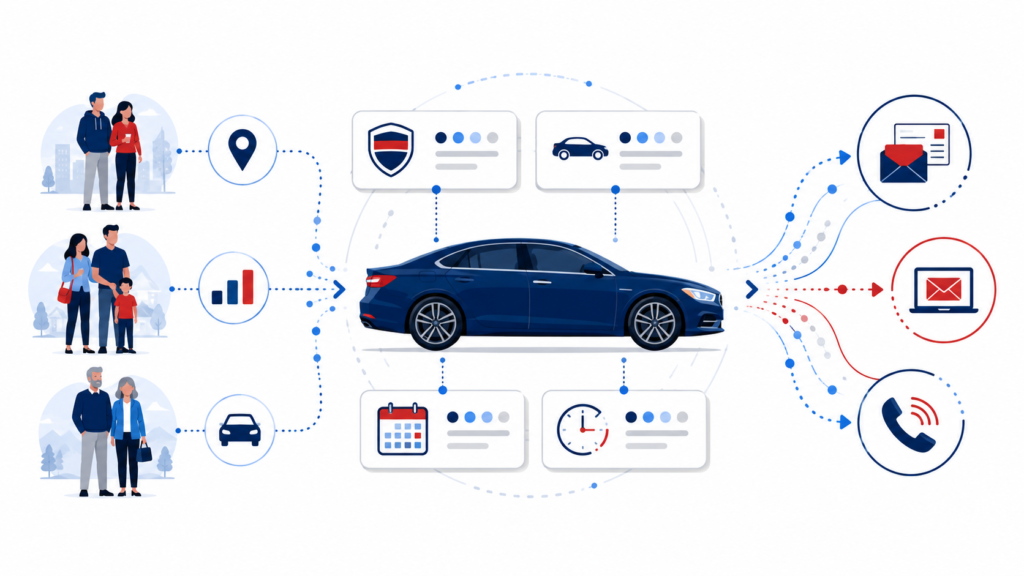
An auto buyer mailing list is a targeted database of vehicle owners and recent car buyers organized by vehicle data, demographics, and geographic location. For dealerships, service centers, aftermarket parts companies, extended warranty providers, and automotive insurance firms, auto buyer mailing lists are the most precise way to reach consumers who are statistically most likely to need your products or services — based on what they drive, when they bought it, and when their lease or warranty expires.
The automotive industry generates some of the strongest direct mail response rates of any vertical. According to the ANA/DMA 2025 Response Rate Report, automotive campaigns average a 3.84% response rate — well above the all-industry average. The reason is simple: vehicle data allows exceptionally precise timing and targeting that matches your offer to the consumer’s actual situation.
What Is in an Auto Buyer Mailing List?
A comprehensive auto buyer list combines vehicle data with consumer demographic data to create a complete profile of each contact.
Vehicle-level data: Make, model, model year, body style, new vs. used purchase, purchase date, estimated purchase price, lease vs. finance indicator, estimated lease expiration date, estimated loan payoff date, vehicle class (sedan, SUV, truck, luxury, economy), fuel type, and VIN-level data where available.
Consumer-level data: Full name, home mailing address, phone number, email address, age, estimated household income, homeownership status, number of vehicles in household, and geographic location.
This combination of vehicle-specific and consumer-demographic data is what makes auto buyer lists so powerful. You are not just reaching “car owners” — you are reaching the owner of a 2022 Honda CR-V with an estimated lease expiration in March 2025 who lives within 15 miles of your dealership and has a household income above $75,000.
Key Targeting Filters for Auto Buyer Lists
Make and model. Target owners of specific brands or vehicle models. A Toyota dealership can reach Toyota owners approaching trade-in time. An aftermarket performance parts company can reach owners of specific sport models.
Model year. Filter by vehicle age to match your offer to the consumer’s situation. Newer vehicles (1-3 years old) are prime targets for extended warranty and service plans. Older vehicles (5-8+ years) are prime targets for trade-in offers and aftermarket services.
Lease expiration date. This is the single most valuable filter for dealerships. Consumers with leases expiring within 60-90 days are actively deciding whether to buy out their lease, lease a new vehicle, or purchase — making them the highest-intent automotive leads available.
Purchase date. Consumers who purchased 3-5 years ago are entering the typical trade-in window. Those who purchased 5-7 years ago may be experiencing increased maintenance costs that make a new vehicle attractive.
New vs. used. Separate new-car buyers from used-car buyers to tailor your messaging and offer. A consumer who bought a certified pre-owned vehicle has different priorities than someone who bought brand new.
Vehicle class. Target by vehicle category — sedan owners for sedan offers, SUV owners for SUV promotions, truck owners for truck accessories. A luxury brand can target existing luxury vehicle owners rather than mass-market buyers.
Geographic radius. Filter by distance from your dealership or service center. Most automotive purchases happen within 20-30 miles of the buyer’s home. Tighter geographic targeting reduces waste on consumers who are unlikely to visit your location.
Household income. Income filtering ensures you are reaching consumers who can afford the vehicles or services you are offering. A luxury dealership targeting $150K+ households will produce better results than mailing to all vehicle owners regardless of income.
Who Uses Auto Buyer Mailing Lists?
New and Used Car Dealerships
Dealerships use auto buyer lists for conquest marketing (targeting owners of competing brands to win them over), lease-expiration campaigns (reaching consumers 60-90 days before their lease ends), trade-in promotions (targeting owners of vehicles 3-5+ years old), service retention (reaching past customers approaching their next service interval), and new model launch campaigns (targeting owners of the previous generation model).
Aftermarket Parts and Accessories Companies
Companies selling performance parts, accessories, protective coatings, and custom modifications use make/model/year targeting to reach owners of specific vehicles that are compatible with their products.
Extended Warranty and Vehicle Service Contract Providers
Warranty companies target owners of vehicles approaching or past their manufacturer warranty expiration — typically 3-5 years from purchase or 36,000-60,000 miles. Model year and purchase date filters are essential for this targeting.
Auto Insurance Companies
Insurance providers use auto buyer data combined with demographic filters (age, income, driving record indicators) to target consumers who may be shopping for better rates — particularly after a vehicle purchase, a move, or a life change.
Service Centers and Quick Lube Chains
Independent service centers use geographic and vehicle-age targeting to reach vehicle owners within their service radius whose vehicles are likely due for maintenance, tire replacement, or repairs.
Auto Loan and Refinancing Companies
Lenders use purchase date and estimated loan balance data to target consumers who may benefit from refinancing at lower rates, or who are approaching payoff and may be ready for a new vehicle purchase.
Best Marketing Channels for Auto Buyer Campaigns
Direct mail is the dominant channel for automotive marketing — and for good reason. A personalized mail piece showing the consumer’s current vehicle make/model with a specific trade-in value or lease-end offer creates immediate relevance. Automotive direct mail response rates of 3.84% significantly outperform digital channels for this industry.
Email marketing works well as a follow-up channel, delivering service reminders, seasonal promotions, and new inventory alerts. Email campaigns must comply with CAN-SPAM requirements.
Telemarketing is effective for high-value leads — particularly lease-expiration contacts and recent service inquiries. A personal phone call from a sales consultant to a consumer whose lease expires next month is one of the highest-converting touchpoints in automotive marketing.
SMS marketing works for appointment confirmations, service reminders, and time-sensitive offers (weekend sales events, end-of-month clearance). All SMS campaigns require TCPA compliance.
Timing: When to Reach Auto Buyers
Vehicle data allows time-based targeting that is impossible with generic consumer mailing lists. The key timing windows for automotive marketing are:
60-90 days before lease expiration: The consumer is actively deciding their next move. This is the highest-intent window for lease-end campaigns.
3-5 years after purchase: The consumer is entering the typical trade-in consideration window. Equity has built up, the vehicle is starting to show age, and the appeal of something new is growing.
30-60 days after purchase: The consumer has just bought a vehicle and is in “accessorizing mode” — purchasing accessories, protection products, and extended service plans.
Manufacturer warranty expiration: As the factory warranty expires (typically 3 years/36,000 miles for bumper-to-bumper, 5 years/60,000 miles for powertrain), consumers become receptive to extended warranty offers.
Seasonal windows: Tax refund season (February-April) and end-of-year clearance events (November-December) are peak periods for vehicle purchase decisions.
Frequently Asked Questions
What is an auto buyer mailing list?
An auto buyer mailing list is a targeted database of vehicle owners and recent car buyers organized by vehicle data (make, model, year, purchase date, lease expiration), consumer demographics (age, income, location), and contact information (mailing address, phone, email). It is used by dealerships, aftermarket companies, warranty providers, and automotive service businesses.
Can I target auto buyers by specific make and model?
Yes. Auto buyer lists can be filtered by specific make (Toyota, Ford, BMW), model (Camry, F-150, 3 Series), model year, body style, new vs. used, and vehicle class. This allows precise targeting — for example, reaching owners of 2021-2023 Honda CR-Vs within 20 miles of your dealership.
How do I reach consumers whose leases are expiring?
Auto buyer lists can be filtered by estimated lease expiration date. Target consumers with leases expiring in the next 60-90 days for the highest-intent leads. Your list broker can pull this data filtered by make, model, and geographic radius around your dealership.
What response rates can I expect from auto buyer direct mail?
Automotive direct mail campaigns average a 3.84% response rate according to the ANA/DMA 2025 report. Well-targeted campaigns using lease-expiration or trade-in timing can exceed this average significantly.
How much do auto buyer mailing lists cost?
Auto buyer lists are specialty consumer data priced at a premium over standard compiled lists due to the vehicle-level data involved. Pricing varies based on volume, targeting depth, and channel. Contact a list broker for a custom quote.
Find Your Next Automotive Customers
At ProMarketing Leads, we build precisely targeted auto buyer mailing lists filtered by make, model, year, lease expiration, purchase date, and geographic radius — giving dealerships and automotive businesses the data they need to reach the right buyers at the right time.
Contact us today for a free consultation. Call (866) 397-2772 to speak with a list expert.