

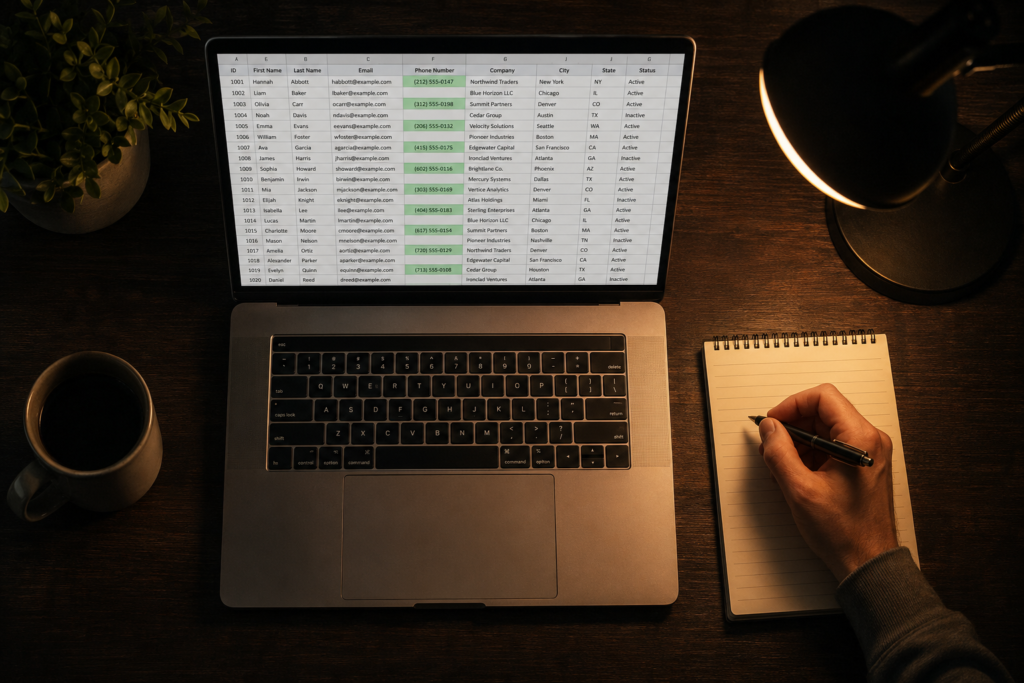
Your customer database has names, emails, and mailing addresses — but the phone number column is full of gaps. That’s a revenue problem. Without phone numbers, your outbound sales team can’t call prospects, your customer service team can’t proactively reach at-risk accounts, and your multichannel campaigns are limited to channels your contacts might ignore. Phone appending solves this by matching your existing records against carrier and consumer databases to fill in the missing numbers.
But not all phone append services are equal. Match rates vary from 25% to 70% depending on the provider, pricing models are opaque, and the difference between getting a valid cell phone number and a disconnected landline can make or break your campaign. This guide covers how phone appending works, what it costs, and how to evaluate providers so you get data that actually connects you to the people you want to reach.
What Is Phone Appending?
Phone appending is the process of adding missing phone numbers to an existing database by matching your records against external data sources. You provide a file containing contact information — typically name, postal address, and email address — and the append service returns your file with phone numbers added to every record they can match. For a technical overview of the process, see our explainer on how phone number appending works.
Phone append services access multiple data sources to find matches: consumer telephone databases, carrier records, public utility filings, directory assistance records, commercial data exchanges, and proprietary consumer survey data. The best providers cross-reference multiple sources and verify that each appended number is active and correctly associated with the named individual before returning it.
Types of Phone Append Services
Cell Phone Append
Cell phone append specifically targets mobile numbers. This is the most in-demand append type because mobile numbers are required for SMS marketing, are the primary contact method for most consumers under 50, and reach people directly rather than going to a shared household landline. Cell phone match rates are typically lower than landline (30% to 55%) because mobile numbers are less frequently listed in public directories. However, the value per matched record is significantly higher.
Landline Append
Landline append adds traditional home or business phone numbers. Match rates are generally higher (40% to 65%) because landline numbers have historically been listed in public directories. Landline data is most useful for B2B telemarketing (business main lines), home services marketing (reaching homeowners), and customer service outreach. The limitation: landline numbers are declining as consumers cut the cord — U.S. landline subscriptions have dropped over 70% since 2000.
Reverse Phone Append
Reverse phone append works in the opposite direction: you provide phone numbers and the service returns the associated names, postal addresses, email addresses, and demographic data. This is useful for enriching lead lists where you have a phone number from a web form or call log but limited information about the person. Reverse append match rates are typically 50% to 75% for landline numbers and 30% to 50% for cell phones.
Business Phone Append
Business phone append targets commercial phone numbers — direct-dial extensions, department numbers, and company main lines. It matches your business contact records (company name, contact name, title, address) against business directory databases, corporate switchboard records, and professional databases. Business phone append is essential for B2B telemarketing campaigns where reaching the right person at a company requires a direct number rather than the main switchboard.
Batch vs. Real-Time Append
Phone append services typically offer two delivery models:
Batch append is the traditional model. You upload a file, the provider processes it (typically within 24 to 72 hours), and returns the file with phone numbers added. Batch is ideal for one-time database enrichment, pre-campaign list preparation, and periodic data refreshes. Most marketing campaigns use batch append because the data is needed before the campaign launches, not in real time.
Real-time append (API) adds phone numbers instantly as new records enter your system — for example, when a website visitor fills out a lead form with their name and email, an API call returns their phone number in milliseconds so your sales team can follow up immediately. Real-time append is more expensive per lookup but dramatically improves speed-to-lead for sales teams that measure response time in minutes.
What Phone Append Services Cost
Pricing varies by append type, volume, and provider. Here are the general ranges for 2026:
Cell phone append (batch): $0.03 to $0.15 per input record (you pay for every record submitted, not just matches). Some providers charge per match instead — typically $0.08 to $0.25 per successfully appended number. Per-match pricing is generally better for small files; per-record pricing is better for large volumes with expected high match rates.
Landline append (batch): $0.02 to $0.08 per input record, reflecting the lower data acquisition cost for publicly listed numbers.
Reverse phone append (batch): $0.03 to $0.12 per input record for basic identity matching (name and address). Adding demographic enrichment (age, income, homeownership) increases cost to $0.08 to $0.20 per record.
Business phone append (batch): $0.05 to $0.20 per input record, with higher costs for direct-dial numbers (vs. main switchboard) and verified decision-maker contacts.
Real-time API: $0.10 to $0.35 per lookup, with volume discounts for high-throughput implementations. API pricing typically requires a monthly minimum commitment.
Minimum orders range from 1,000 to 10,000 records depending on the provider. Some offer free test batches of 100 to 500 records so you can evaluate match rate and quality before committing to a full order.
How to Evaluate a Phone Append Provider
The phone append market has providers ranging from enterprise data companies to small operators reselling recycled data. Here’s how to tell them apart:
Match rate transparency
A credible provider will give you a realistic match rate estimate based on your file characteristics before you place an order — not just a best-case marketing number. Ask: “What match rate should I expect for a file of [X type of records] with [Y available data fields]?” If the answer is “We’ll need to see your file first,” that’s reasonable. If the answer is “We guarantee 90% matches,” that’s a red flag — no legitimate cell phone append service achieves 90% match rates on consumer data.
Data sourcing and freshness
Ask where the phone numbers come from and how often the data is refreshed. The best providers source from multiple carrier databases, directory assistance records, commercial data exchanges, and proprietary consumer panels — and refresh monthly. Providers who rely on a single source or refresh quarterly will have significantly higher disconnect rates.
Verification methods
After matching a name to a phone number, how does the provider verify the number is valid? Industry-standard verification includes HLR (Home Location Register) lookups to confirm the number is active and the carrier is current, line-type identification to distinguish cell from landline from VoIP, and DNC Registry scrubbing to flag numbers on the Do Not Call list. Ask whether verification is included in the base price or charged as an add-on.
Line type identification
If you need cell phone numbers specifically (for SMS or mobile outreach), the provider must be able to distinguish cell from landline from VoIP. This is a separate data point from the phone number itself and requires real-time carrier lookups. A provider who can’t guarantee line type is selling you a mixed bag of cell, landline, and potentially non-working VoIP numbers.
Compliance support
Phone numbers used for outbound marketing are subject to TCPA regulations and the National DNC Registry. Your provider should scrub all appended numbers against the current DNC list before delivery and flag any numbers that appear on known litigator databases. For cell phone appends, the provider should document that the numbers are associated with the named individual — not a recycled number that now belongs to someone else.
Free test batch
Reputable providers offer a free test append of 100 to 500 records. This lets you verify match rate, line type accuracy, and connectivity before committing to a full order. If a provider won’t offer a test, they likely aren’t confident in their data quality.
Common Mistakes to Avoid
Choosing a provider solely on price. A $0.02-per-record append that returns 30% disconnected numbers is more expensive than a $0.10-per-record append that returns 95% valid, connected numbers. Total cost per connected record is the metric that matters, not cost per input record.
Skipping the test batch. Match rates and data quality vary enormously by provider and by file type. A provider that delivers 55% match rates on consumer files might deliver 25% on business files. Always test before scaling.
Not re-verifying before campaigns. Phone numbers go stale. If you appended numbers three months ago, re-verify before launching a calling campaign. A quick DNC scrub and carrier validation on your file can prevent wasted calls and compliance issues.
Assuming one append type fits all needs. Cell phone append, landline append, and business phone append serve different purposes. If your goal is SMS marketing, you need cell phone append with line type verification specifically. If your goal is B2B cold calling, you need business phone append with direct-dial numbers. Using the wrong type wastes money and produces poor results. For help choosing between append types, see our comparison of email append vs. phone append services.
Getting Started
At ProMarketing Leads, we offer cell phone, landline, business phone, and reverse phone append services — all processed through our network of verified carrier and consumer databases. Every appended number is validated for active status, classified by line type (cell, landline, VoIP), and scrubbed against the National DNC Registry before delivery.
We provide free test batches so you can evaluate match rate and quality before committing. Whether you’re enriching a 2,000-record customer file or appending phone numbers to a 200,000-record prospect database, our data team will match the right append type and data sources to your specific use case.
Contact us for a free test append and quote. Call (866) 397-2772 or request a free quote online.