A business mailing list is only as good as the targeting behind it.
If you sell accounting software, you do not need every business in the country. If you sell packaging equipment, you do not need restaurants, law firms, or dental clinics. If you sell commercial roofing, you may want property managers, warehouse operators, school districts, manufacturers, retail centers, and facility managers.
That is where SIC and NAICS codes help. They classify businesses by industry, giving B2B marketers a cleaner way to build a list around what a company actually does.
Instead of asking for “manufacturers” or “medical companies” in a loose way, you can target specific industry categories and reduce wasted outreach.
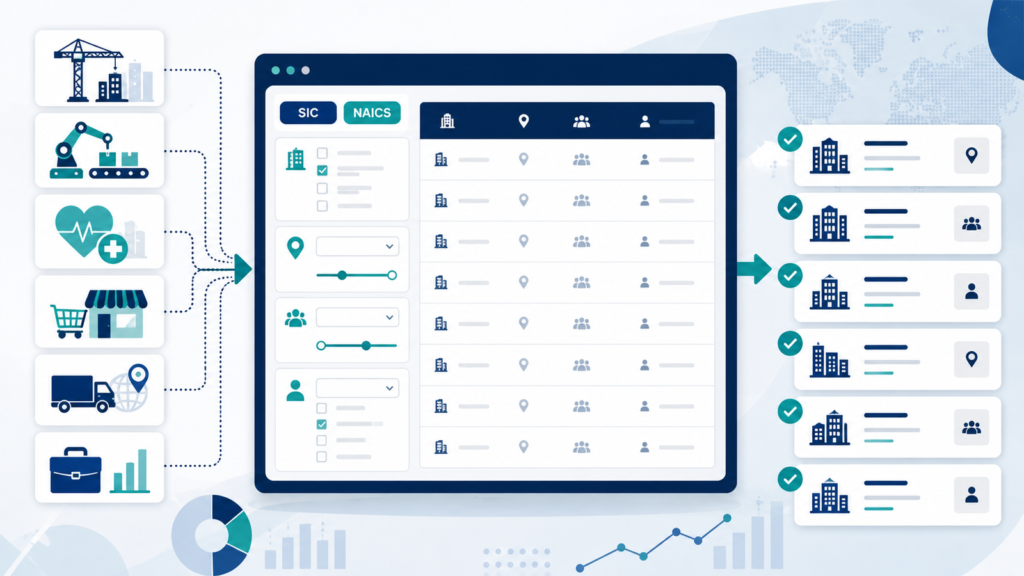
For B2B campaigns, SIC and NAICS targeting can be one of the most useful ways to refine business mailing lists, especially when the campaign needs to reach companies by industry, location, size, and decision-maker type.
What Are SIC Codes?
SIC stands for Standard Industrial Classification.
SIC codes are four-digit industry classification codes used to group businesses by their primary line of activity. OSHA still provides access to the 1987 SIC Manual, including search by keyword, 2-digit, 3-digit, and 4-digit SIC codes.
SIC is an older system, but it has not disappeared from business data. The SEC says SIC codes in EDGAR filings indicate a company’s type of business.
That is why many B2B list databases still use SIC codes. They are familiar, widely recognized, and useful when you need to target broad or specific business categories.
For example, a business mailing list may use SIC codes to identify:
- General contractors
- Plumbing contractors
- Grocery stores
- Auto dealers
- Medical offices
- Accounting firms
- Manufacturers
- Warehouses
- Insurance agencies
- Hotels and motels
For marketers, SIC codes are useful because they let you target by industry without depending on inconsistent company descriptions.
What Are NAICS Codes?
NAICS stands for North American Industry Classification System.
The U.S. Census Bureau says NAICS is the standard used by federal statistical agencies to classify business establishments for collecting, analyzing, and publishing statistical data about the U.S. business economy.
NAICS was developed by the United States, Canada, and Mexico to provide comparable industry statistics across the three countries. The Census Bureau also states that NAICS replaced SIC as the federal standard in 1997.
NAICS usually allows more detailed industry classification because it uses a six-digit hierarchical structure, compared with SIC’s four-digit structure.
For example, the first two digits identify a broad sector. A construction business may fall under sector 23. A manufacturing business may fall under sectors 31 to 33. A professional services business may fall under sector 54.
For B2B marketers, that structure matters because it allows more precise list targeting.
SIC vs. NAICS: What Is the Difference?
Both systems classify businesses by industry, but they are not the same.
| Factor | SIC Codes | NAICS Codes |
|---|---|---|
| Full name | Standard Industrial Classification | North American Industry Classification System |
| Typical structure | Four digits | Six digits |
| Status | Older U.S. classification system | Current federal statistical standard |
| Still used in | Business databases, legacy systems, and some filings | Federal statistics, modern industry classification, and many business databases |
| Best for | Broad industry targeting and legacy list selection | More detailed industry targeting |
| Marketing use | Still common in B2B list building | Very useful for refined B2B targeting |
The Census Bureau says NAICS replaced SIC as the federal standard in 1997. That does not mean SIC is useless. It means NAICS is the modern federal classification standard, while SIC remains common in many business data and marketing contexts.
Use NAICS when you want the current federal industry classification standard and more detailed industry selection.
Use SIC when your data source, sales process, legacy campaign history, or business database still relies on SIC categories.
Use both when you need to compare or refine business audiences across different data sources.
Why SIC and NAICS Codes Matter for B2B Mailing Lists
B2B targeting fails when the audience definition is too broad.
A company may say, “We want to target healthcare businesses.” But that could mean hospitals, private practices, urgent care centers, nursing homes, medical labs, dentists, chiropractors, pharmacies, medical device companies, or healthcare consultants.
Those are very different buyers.
A better campaign starts with a tighter industry definition. SIC and NAICS codes help answer questions like:
- Which industries are most likely to need this offer?
- Which businesses should be excluded?
- Are we targeting companies, facilities, offices, or headquarters?
- Are we targeting a broad sector or a narrow niche?
- Does the campaign need local, regional, or national coverage?
- Should the list be filtered further by size, revenue, location, or job title?
This matters because a B2B mailing list is not just a list of companies. It is a sales audience.
Example: Targeting Construction Companies
“Construction companies” sounds specific, but it is still broad.
A campaign could target:
- Residential builders
- Commercial builders
- Electrical contractors
- Plumbing contractors
- Roofing contractors
- Highway and street contractors
- Excavation contractors
- Specialty trade contractors
- Concrete contractors
- HVAC contractors
These businesses may share a broad industry category, but they do not buy the same products in the same way.
A company selling heavy equipment financing may want a different construction list than a company selling roofing leads, jobsite safety software, building materials, payroll services, or commercial insurance.
SIC and NAICS codes help separate those audiences.
Example: Targeting Manufacturing Companies
Manufacturing is another category that can become too broad very quickly.
A manufacturer may produce food products, chemicals, plastics, metal parts, electronics, machinery, furniture, textiles, or medical devices.
A packaging supplier, logistics provider, staffing firm, industrial automation company, or safety training provider may all target manufacturers, but not necessarily the same manufacturers.
With SIC or NAICS targeting, the list can be narrowed by industry type before adding other filters such as:
- Employee count
- Revenue range
- Number of locations
- Geographic area
- Executive title
- Facility type
- Years in business
- Phone availability
- Email availability
- Mailing address quality
That makes the campaign more focused from the beginning.
Example: Targeting Healthcare Businesses
Healthcare is a large and sensitive category. Broad targeting can create waste and compliance risk.
A campaign may need to distinguish between:
- Physicians
- Dentists
- Chiropractors
- Hospitals
- Nursing care facilities
- Medical laboratories
- Pharmacies
- Outpatient centers
- Mental health providers
- Medical equipment suppliers
- Healthcare administrators
A medical software company may want one list. A staffing agency may want another. A continuing education provider may want another. A medical device company may need a list filtered by specialty, facility type, and role.
Industry codes can help structure the first layer of targeting, while healthcare-specific fields can refine the final audience.
SIC and NAICS Are Starting Points, Not the Whole List Strategy
This is important.
SIC and NAICS codes tell you the industry category. They do not tell you everything you need to know about whether a company is a good prospect.
A strong B2B mailing list may also use:
- Company name
- Mailing address
- Phone number
- Website
- Executive or decision-maker name
- Job title
- Employee count
- Revenue range
- Location count
- Headquarters or branch location
- Years in business
- Public or private status
- Franchise or independent status
- Email availability
- Mobile or direct-dial availability, where appropriate
- Geographic radius
- State, county, city, ZIP code, or carrier route
Think of SIC and NAICS as the industry filter. The best campaign usually adds more filters after that.
How to Use SIC and NAICS Codes in a Campaign
Start with the buyer, not the code. Do not begin by asking, “What SIC code do I need?” Start with the buyer. Who is most likely to need your product or service? What type of company has the pain point? Who has the budget? Who has the authority?
Use codes to define the industry universe. Once you know the buyer profile, use SIC or NAICS codes to build the industry universe. This could include contractors, medical offices, manufacturers, accounting firms, logistics companies, or other target categories.
Add geography. Industry targeting without geography can make the list too large. Use state, county, city, ZIP code, radius, service territory, or sales territory to control the audience.
Add company size filters. Not every company in an industry is a fit. Employee count, annual revenue, number of locations, headquarters status, and facility size can all help refine the list.
Add decision-maker data. A company list is useful. A company list with the right contacts is more useful. Depending on the offer, you may need owners, executives, operations managers, HR directors, facility managers, or purchasing contacts.
Match the list to the outreach channel. A SIC or NAICS targeted list can support direct mail lists, email marketing lists, telemarketing lists, or a multichannel campaign.
Common Mistakes When Buying SIC or NAICS Business Lists
Targeting Too Broadly
A broad list may look attractive because it has more records. But more records do not always mean more opportunity.
If the campaign is not relevant to half the list, the extra records become waste.
Using Only One Code
Some campaigns need multiple SIC or NAICS codes.
For example, a company selling commercial security systems may want warehouses, schools, retail locations, office buildings, healthcare facilities, and manufacturing plants. One code may not cover the full market.
Forgetting Exclusions
Good targeting is not just about who to include. It is also about who to remove.
A campaign may need to exclude:
- Very small companies
- National chains
- Franchises
- Home-based businesses
- Government entities
- Nonprofits
- Competitors
- Existing customers
- Locations outside the service area
Exclusions can improve list quality quickly.
Confusing Company Industry With Buyer Role
A NAICS or SIC code tells you the company’s industry. It does not tell you which person inside the company should receive the message.
For example, a logistics company may be the right account, but the buyer could be the operations director, fleet manager, warehouse manager, HR manager, or owner depending on the offer.
Assuming Every Business Has Only One Useful Classification
Some businesses are complex. A company may manufacture, distribute, install, and service products. A healthcare organization may operate multiple facility types. A construction company may handle several trades.
That is why list review and broker guidance matter.
SIC or NAICS: Which Should You Use?
Use the system that best fits your data source and campaign.
In many modern B2B campaigns, NAICS is preferred because it is the current federal statistical standard and offers a more detailed structure. The Census Bureau identifies NAICS as the standard for federal statistical agencies and says it replaced SIC as the federal standard in 1997.
SIC may still be useful when:
- The list source is organized by SIC
- Your sales team already uses SIC categories
- You are targeting older or legacy business databases
- You need broad industry grouping
- You are comparing against historical campaign data
- You are working with filings or data sources that still reference SIC
The practical answer is simple: use whichever code system gives the cleanest, most accurate targeting for the campaign. If both are available, review both.
What a Good List Broker Should Ask Before Building Your List
A serious B2B list conversation should not begin and end with “What industry do you want?”
A good list broker should ask:
- What do you sell?
- Who buys it?
- Which industries are already good customers?
- Are you targeting businesses, locations, or decision-makers?
- Do you need SIC codes, NAICS codes, or both?
- Which industries should be excluded?
- What geography do you serve?
- What company size is ideal?
- Do you need direct mail, email, phone, or multiple channels?
- Do you need owners, executives, managers, or department heads?
- Do you need headquarters, branches, or both?
- Are there compliance issues tied to your campaign?
- What format does your sales or marketing team need?
This is where working with a list broker matters. ProMarketing Leads can help build custom marketing list packages using business lists, direct mail lists, email lists, telemarketing leads, text message marketing, and specialty mailing lists.
If your campaign targets newly opened companies, you may also want to review new business lists. If you are still deciding whether to target businesses or households, see the guide on consumer mailing lists vs. business mailing lists.
Final Answer
Business mailing lists by SIC and NAICS code help B2B marketers target companies by industry with far more precision than broad category names.
SIC codes are older but still common in business databases and some filings. NAICS codes are the current federal statistical standard and provide a more detailed structure for modern industry classification.
The best campaign does not stop at the code. It combines industry classification with geography, company size, decision-maker data, channel selection, and exclusions.
If you want to reach the right companies, start with the buyer profile. Then use SIC and NAICS codes to build a cleaner, sharper, more useful B2B mailing list.
Need a Business Mailing List by SIC or NAICS Code?
Talk with a ProMarketing Leads list expert. We can help you build a targeted business mailing list by industry, location, company size, decision-maker type, SIC code, NAICS code, or outreach channel.
Call (866) 397-2772FAQs
What Is a SIC Code Mailing List?
A SIC code mailing list is a business mailing list filtered by Standard Industrial Classification codes. These four-digit codes group companies by industry, making it easier to target specific types of businesses.
What Is a NAICS Code Mailing List?
A NAICS code mailing list is a business list filtered by North American Industry Classification System codes. NAICS is the current federal statistical standard used to classify business establishments by industry.
Are SIC Codes Still Used?
Yes. SIC is older and was replaced by NAICS as the federal statistical standard in 1997, but SIC codes are still used in some business databases, marketing lists, and SEC filings.
Is NAICS Better Than SIC for B2B Targeting?
NAICS is often better for more detailed industry targeting because it is the current federal statistical standard and uses a six-digit hierarchical structure. SIC can still be useful for legacy databases, broad industry groups, and campaigns built around older business data.
Can I Target Companies by Both SIC and NAICS Code?
Yes. Many B2B list strategies can consider both SIC and NAICS codes, especially when the campaign needs accurate industry targeting across different data sources.
What Else Should I Add to a SIC or NAICS Business List?
You can refine the list by geography, employee count, revenue, number of locations, job title, executive name, phone availability, email availability, headquarters or branch location, and other campaign-specific filters.
Are SIC and NAICS Codes Enough to Build a Good List?
No. They are useful industry filters, but they are not the whole strategy. A good business mailing list also needs clean contact data, geographic targeting, company size filters, decision-maker selection, and proper exclusions.
What Industries Can Be Targeted With SIC and NAICS Codes?
Common examples include construction, manufacturing, healthcare, finance, insurance, real estate, logistics, retail, wholesale trade, professional services, education, hospitality, and many specialty business categories.