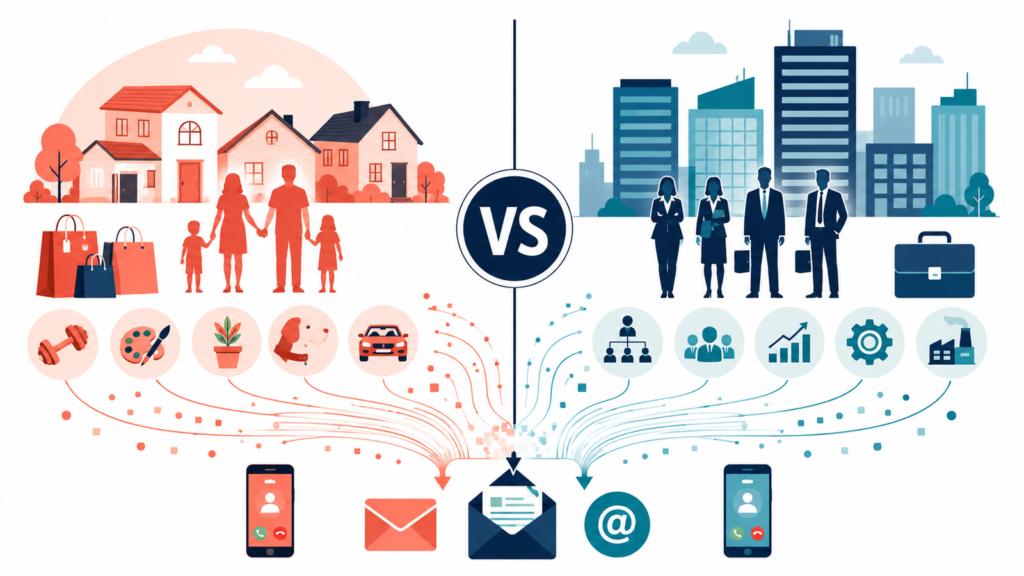
Consumer mailing lists and business mailing lists are the two foundational data types in direct marketing, and choosing the wrong one is the fastest way to waste a campaign budget. A consumer mailing list targets individuals in their personal capacity based on who they are, where they live, and how they spend. A business mailing list targets companies and their decision-makers based on industry, size, revenue, and job function.
The distinction matters because these two list types use different data structures, different targeting logic, different pricing models, and different compliance rules. Understanding the differences, and when to use each, ensures your marketing dollars reach the right audience through the right channel with the right message.
What Is a Consumer Mailing List?
A consumer mailing list is a database of individual people organized by personal demographic, geographic, behavioral, and lifestyle attributes. These lists are built from public records, property deeds, vehicle registrations, census data, survey responses, purchase transaction records, subscription data, and other consumer data sources.
A standard consumer list includes the individual’s full name, home mailing address, and may also include phone numbers, email addresses, age, date of birth, gender, estimated household income, home value, homeownership status, marital status, presence of children, education level, ethnicity, and a wide range of lifestyle and interest indicators.
Consumer lists are used for B2C marketing, reaching people at home about products and services they buy in their personal lives.
What Is a Business Mailing List?
A business mailing list is a database of companies and their key personnel organized by firmographic and professional attributes. These lists are compiled from business registrations, professional license databases, trade directories, corporate filings, and verified business data providers.
A standard business list includes the company name, business address, phone number, website, SIC or NAICS industry classification code, number of employees, estimated annual revenue, years in business, and ownership type. At the contact level, it includes the decision-maker’s name, job title, department, direct phone number, and direct email address.
Business lists are used for B2B marketing, reaching professionals at work about products and services their companies need to operate and grow.
Consumer vs. Business Mailing Lists: Side-by-Side Comparison
| Attribute | Consumer Mailing Lists | Business Mailing Lists |
|---|---|---|
| Target audience | Individuals and households | Companies and decision-makers |
| Primary data type | Demographics, age, income, homeownership, interests | Firmographics, industry, employee count, revenue, job title |
| Address type | Residential / home address | Business / office address |
| Data sources | Public records, surveys, purchase data, subscriptions | Business registrations, directories, corporate filings, professional licenses |
| Key targeting filters | Age, income, home value, interests, purchase behavior, life events | SIC/NAICS code, company size, revenue, job title, department |
| Typical purchase value | Lower per-transaction; higher volume | Higher per-transaction; longer sales cycle |
| Sales cycle | Short, days to weeks | Long, weeks to months |
| Decision-making | Individual or household | Multiple stakeholders / committee |
| Data decay rate | Moderate, people move, but less frequently | High, roughly 30% annually due to job changes |
| Pricing | Generally lower CPM for compiled lists | Higher CPM due to contact-level verification |
| Best channels | Direct mail, email, SMS, telemarketing | Direct mail, email, telemarketing, LinkedIn |
When to Use a Consumer Mailing List
Use a consumer mailing list when your product or service is marketed to individuals in their personal lives. Consumer lists are the right choice when your customer is a person making a household purchasing decision rather than a company making a business procurement decision.
Consumer lists are widely used across these industries and use cases:
Home services. HVAC, plumbing, roofing, landscaping, and pest control companies use consumer lists filtered by homeownership status, home value, and geographic radius. New homeowner mailing lists and new mover lists are especially valuable because they reach people at a moment when they are actively seeking local services.
Financial services. Insurance agents, mortgage brokers, and financial advisors use income-qualified consumer lists and investor mailing lists to reach high-net-worth individuals.
Healthcare. Hospitals, clinics, and wellness brands use ailment-targeted lists and demographic data to reach patients with relevant health conditions or life stages.
Real estate. Agents and brokers use real estate leads and homeowner data to identify likely buyers and sellers in specific markets.
Automotive. Dealerships and aftermarket companies use auto buyer mailing lists filtered by vehicle make, model, year, and lease expiration.
Retail, e-commerce, and subscription brands. Consumer brands use hobby and interest-based lists, purchase behavior data, and lifestyle indicators to reach their ideal shoppers.
When to Use a Business Mailing List
Use a business mailing list when your product or service is sold to companies, organizations, or professionals in their work capacity. Business lists are the right choice when the buying decision involves a specific role within a company, a CEO, procurement manager, IT director, or practice administrator.
Business lists are widely used across these industries and use cases:
Technology and SaaS. Software companies use B2B lists filtered by technology stack, company size, and IT department contacts to reach qualified buyers.
Professional services. Law firms, accounting firms, staffing agencies, and marketing agencies use title-level targeting to reach the functional leaders who would engage their services.
Healthcare and medical B2B. Pharmaceutical companies, medical device manufacturers, and healthcare service providers use medical mailing lists and nurse mailing lists to reach physicians, hospital administrators, and clinical professionals.
Commercial services. Office suppliers, commercial cleaning companies, facility management firms, and commercial insurance brokers use firmographic filters to identify companies in their service area that match their ideal client profile.
Wholesale and manufacturing. Companies selling to other businesses in bulk use SIC/NAICS code targeting and revenue filters to reach purchasing decision-makers in their target verticals.
Targeting: How Filtering Differs Between the Two
Consumer List Filters
Consumer targeting is built around who the person is and how they live. The most common filters include geographic location, ZIP code, city, county, radius, age range, gender, estimated household income, home value and homeownership status, own vs. rent, marital status and family composition, education level, interests and hobbies, gardening, golf, cooking, fitness, purchase behavior, mail-order buyers, online shoppers, and life events such as recently purchasing a home, recently relocating, turning 65, or having a child.
Business List Filters
Business targeting is built around what the company does and who makes decisions within it. The most common filters include SIC or NAICS industry classification code, geographic location, state, city, ZIP code, number of employees, 1-4, 5-19, 20-99, 100-499, 500+, estimated annual revenue, years in business, ownership type, public, private, franchise, nonprofit, specific job title or function, CEO, CFO, Marketing Director, IT Manager, and department, sales, marketing, finance, operations, HR, IT.
The critical difference is the contact layer. Consumer lists identify individuals directly. Business lists must identify both the right company and the right person within that company, which is why B2B data carries higher per-record costs due to the additional verification required.
Pricing Differences
Consumer mailing lists are generally less expensive per record than business lists, particularly for compiled data. Consumer data is largely sourced from public records, property deeds, vehicle registrations, voter files, that can be compiled at scale and refreshed efficiently.
Business mailing lists carry higher per-record costs because B2B data requires ongoing human verification. Job titles change, people switch companies, phone numbers are reassigned, and email addresses become invalid. Industry estimates suggest that roughly 30% of B2B contact data becomes inaccurate within a single year, which means providers must invest significantly in keeping business data current.
Both consumer and business lists are typically priced on a cost-per-thousand, CPM, basis, with additional surcharges for deeper targeting selects, behavioral data, financial attributes, specialty filters. A list broker can help you compare pricing across data sources and find the best value for your specific targeting criteria.
Channel Considerations
Both consumer and business lists support multichannel marketing across direct mail, email, telemarketing, and SMS. However, channel effectiveness varies between the two.
Direct mail performs strongly for both consumer and business campaigns. For consumer campaigns, it reaches people at home where purchasing decisions are made. For B2B campaigns, a personalized mail piece addressed to a specific decision-maker by name stands out on a business desk.
Email is highly effective for both, but the approach differs. Consumer email campaigns tend to be shorter, more visual, and offer-driven. B2B email campaigns tend to be more detailed, value-proposition focused, and often part of a longer nurturing sequence.
Telemarketing is particularly powerful for B2B because it creates a direct, two-way conversation with the decision-maker. For consumer campaigns, telemarketing works well for high-consideration purchases, insurance, home improvement, financial services, but requires careful compliance management.
SMS marketing is growing rapidly for both consumer and B2B outreach. Consumer SMS campaigns work well for time-sensitive local offers. B2B SMS is effective for appointment confirmations, event reminders, and short follow-ups. Both require strict TCPA compliance.
Compliance Differences
The core compliance frameworks, CAN-SPAM for email, TCPA for phone and SMS, and DNC registry requirements for telemarketing, apply equally to consumer and business lists. However, there are practical differences worth noting.
Consumer data involves additional sensitivity around financial attributes, income, net worth, credit indicators, health-related data, ailment-targeted lists, and demographic attributes, ethnic mailing lists. Responsible use of these data points requires working with a provider who sources data ethically and complies with applicable privacy regulations.
Business data involves specific considerations around professional email addresses, many are validated through corporate domains with stricter spam filtering, direct-dial phone numbers, which may be personal mobile numbers requiring TCPA consent for marketing texts, and international business contacts, subject to GDPR, CASL, or other regional regulations.
Can You Use Both?
Many businesses benefit from using both consumer and business mailing lists, either for different campaigns or as part of a combined strategy.
A commercial insurance broker, for example, might use business lists to target CFOs and risk managers at mid-sized companies for commercial coverage, while simultaneously using consumer lists to reach high-income homeowners for personal umbrella policies.
A financial advisor might use investor mailing lists, consumer data, to reach individual accredited investors, while also using B2B lists to target CFOs and business owners for corporate retirement plan services.
If your business serves both individual consumers and other businesses, the best approach is to run separate campaigns with separate lists, separate messaging, and separate offers tailored to each audience. A list broker can help you build and manage both data types from a single consultation.
How to Decide: A Quick Framework
Choose a consumer mailing list if: Your buyer is an individual or household. The purchase decision is personal, not a business expense. Your targeting criteria are demographic or lifestyle-based. You sell home services, retail products, insurance, healthcare, real estate, or financial services to individuals.
Choose a business mailing list if: Your buyer is a company or organization. The purchase decision involves a specific professional role, CEO, IT Director, Procurement Manager. Your targeting criteria are firmographic, industry, size, revenue. You sell software, commercial services, professional services, wholesale goods, or B2B solutions.
Use both if: Your product or service has both individual and business applications. You serve different market segments with different offers. You want to reach business owners both at work, business list, and at home, consumer list, for maximum coverage.
Frequently Asked Questions
What is the main difference between consumer and business mailing lists?
Consumer mailing lists target individuals based on personal demographics like age, income, and lifestyle. Business mailing lists target companies and their decision-makers based on firmographic data like industry, company size, revenue, and job title. The choice depends on whether your product is sold to people in their personal lives or to companies through professional buyers.
Which type of mailing list is more expensive?
Business mailing lists generally cost more per record than consumer lists. B2B data requires ongoing verification of job titles, direct phone numbers, and email addresses, which change frequently as people switch roles and companies. Consumer data relies more on public records that can be compiled at scale.
Can I buy a list that includes both consumer and business data?
While some data providers offer lists that combine both data types, it is generally more effective to use separate lists with separate campaigns tailored to each audience. Consumer and business recipients respond to different messaging, offers, and channels. A list broker can help you build and manage both from a single consultation.
Which list type produces higher response rates?
Response rates depend more on targeting precision and offer relevance than on the list type itself. A well-targeted consumer list with a strong offer can outperform a poorly targeted business list, and vice versa. The key factor is matching your list selection to your audience and campaign objectives.
What channels work best for each list type?
Both consumer and business lists support direct mail, email, telemarketing, and SMS. Consumer campaigns often perform especially well with direct mail and SMS due to the personal, home-based context. Business campaigns often excel with email and telemarketing because these channels allow for more detailed, consultative messaging directed at specific decision-makers.
How often should I refresh my mailing list?
Consumer lists should be updated at least every 90 days through NCOA, National Change of Address, processing. Business lists need more frequent attention, ideally monthly verification, because B2B data decays at roughly 30% per year due to job changes and company turnover.
Find the Right List for Your Next Campaign
Whether you need consumer mailing lists, business mailing lists, or both, ProMarketing Leads has the data and the expertise to build precisely targeted lists from our network of over 40,000 unique data sources.
Contact us today for a free consultation and custom quote. Call (866) 397-2772 to speak with a list expert.