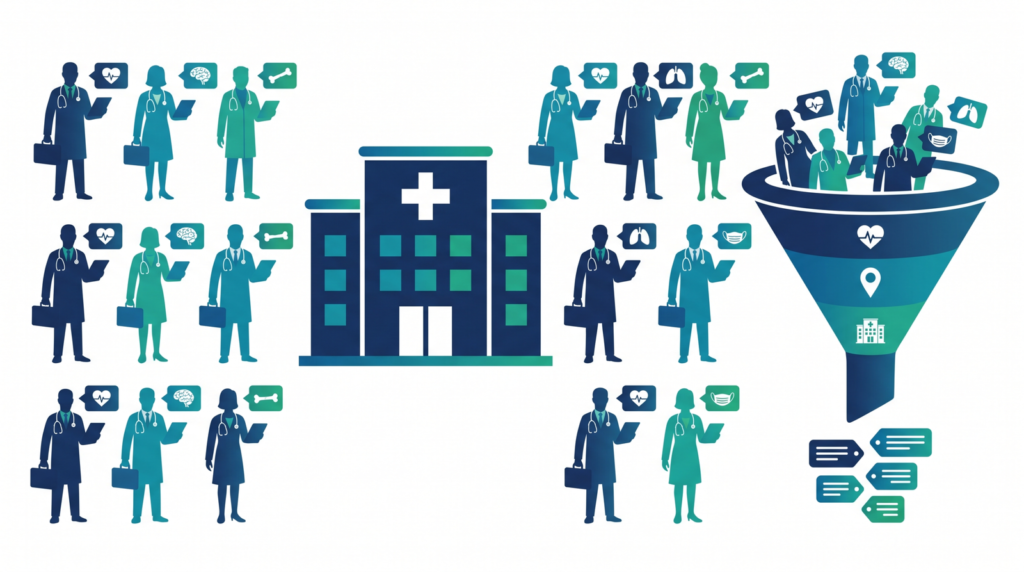
A medical mailing list is a targeted database of healthcare professionals — physicians, nurses, pharmacists, hospital administrators, and allied health workers — organized by medical specialty, credentials, facility type, and geographic location. For any business that sells products or services to the healthcare industry, a well-targeted medical mailing list is the most direct path to reaching the clinical and administrative decision-makers who control purchasing budgets.
The U.S. healthcare industry represents over $5 trillion in annual spending, with approximately 1.1 million active physicians, over 4 million registered nurses, and thousands of hospitals, clinics, and outpatient facilities making purchasing decisions every day. Reaching the right professionals within this massive ecosystem requires specialized data that goes far beyond what a standard business mailing list can offer.
What Is Included in a Medical Mailing List?
A comprehensive medical mailing list typically includes data at both the individual and facility level.
Individual-level data: Full name, credentials (MD, DO, RN, NP, PA, PharmD), medical specialty or subspecialty, NPI (National Provider Identifier) number, state license number, license status (active, inactive), practice address, direct phone number, email address, medical school and graduation year, years in practice, and board certification status.
Facility-level data: Facility name, facility type (hospital, clinic, private practice, ambulatory surgery center, long-term care facility, academic medical center), number of beds (for hospitals), number of physicians or staff, Medicare/Medicaid participation status, geographic location, and parent health system affiliation.
The NPI number is particularly valuable for healthcare marketing because it is a unique 10-digit identifier assigned to every healthcare provider by the Centers for Medicare and Medicaid Services. NPI-based targeting ensures you are reaching a verified, actively licensed provider — not an outdated or retired contact.
Medical Specialties You Can Target
Medical mailing lists can be segmented by virtually any recognized medical specialty. The most commonly targeted specialties include:
Primary care: Family medicine, internal medicine, general practice, pediatrics.
Surgical specialties: General surgery, orthopedic surgery, cardiovascular surgery, neurosurgery, plastic surgery, urological surgery.
Medical specialties: Cardiology, dermatology, endocrinology, gastroenterology, hematology, oncology, nephrology, neurology, pulmonology, rheumatology.
Hospital-based specialties: Anesthesiology, emergency medicine, pathology, radiology, critical care medicine.
Mental health: Psychiatry, psychology, behavioral health counseling.
Allied health professionals: Nurses (RN, LPN, NP, CRNA), physician assistants, pharmacists, physical therapists, occupational therapists, respiratory therapists, medical technologists.
Healthcare administration: Hospital CEOs, CFOs, CMOs, practice administrators, clinical directors, department heads, purchasing managers.
The ability to target by specific specialty is what makes medical lists so powerful. A pharmaceutical company launching a new cardiology drug needs to reach cardiologists specifically — not all physicians. A medical device manufacturer selling orthopedic implants needs orthopedic surgeons and hospital purchasing committees, not general practitioners.
Who Uses Medical Mailing Lists?
Pharmaceutical Companies
Pharma companies use medical mailing lists to promote new drug launches, clinical trial recruitment, prescription updates, and continuing medical education (CME) opportunities directly to prescribing physicians in the relevant specialties.
Medical Device and Equipment Manufacturers
Device companies use specialty-filtered lists to reach the surgeons, clinical department heads, and hospital purchasing managers who evaluate and buy diagnostic equipment, surgical instruments, implants, and clinical technology.
Healthcare Staffing and Recruiting Agencies
Staffing firms use nurse mailing lists and physician databases to recruit clinical professionals for permanent positions, travel assignments, and locum tenens opportunities. The nursing shortage has made targeted nurse recruitment data especially valuable.
Health IT and SaaS Companies
Companies selling electronic health records (EHR), practice management software, telehealth platforms, and revenue cycle management tools use medical lists to reach physician practice owners, hospital CIOs, and clinic administrators who make technology purchasing decisions.
Continuing Education Providers
CME providers and medical conference organizers use specialty-segmented lists to market courses, certifications, and events to physicians and nurses who need to maintain their licensure through continuing education credits.
Insurance and Financial Services
Companies offering malpractice insurance, disability insurance, practice loans, and financial planning services use physician mailing lists filtered by specialty, years in practice, and estimated income to target their highest-value prospects.
How to Buy Medical Mailing Lists: Step by Step
Step 1: Define Your Target Healthcare Professional
Start by identifying exactly which type of healthcare professional you need to reach. Consider their specialty or role, the type of facility they work in (hospital, private practice, clinic, academic medical center), their geographic location, their decision-making authority (are they the end user, the influencer, or the budget holder?), and their career stage (early career, established, approaching retirement).
Step 2: Choose Your Marketing Channel
Medical professionals can be reached through multiple channels, each with its own strengths.
Direct mail remains highly effective for reaching physicians at their practice addresses. A physical mail piece addressed to a doctor by name and specialty stands out in an office setting and avoids the spam filters that block much of healthcare email marketing.
Email marketing works well for educational content, event invitations, and product awareness campaigns. Healthcare email lists require verified professional email addresses — not generic clinic addresses — to ensure your message reaches the intended recipient.
Telemarketing is effective for high-value sales conversations, appointment setting, and clinical trial recruitment. Direct-dial numbers that bypass the front desk are essential for reaching physicians by phone.
SMS marketing is growing in healthcare for appointment-related communications and time-sensitive announcements, though it requires strict TCPA compliance.
Step 3: Select a Specialized Data Provider
Medical mailing lists require a provider with healthcare-specific data expertise. General-purpose business list providers often lack the specialty granularity, NPI verification, and license status validation that healthcare marketing demands.
At ProMarketing Leads, we source medical mailing lists from our network of specialized healthcare data providers — with NPI-verified records, active license confirmation, specialty segmentation, and facility-level targeting. Our list experts consult with you to build the exact healthcare audience your campaign requires.
Step 4: Apply Targeting Filters
Layer your filters to build a precisely targeted list. Common medical list filters include specialty (primary and subspecialty), geographic area (state, MSA, county, ZIP code, radius), facility type, number of years in practice, prescribing volume (for pharmaceutical marketing), hospital bed count, Medicare/Medicaid provider status, and board certification status.
Step 5: Verify Compliance
Healthcare marketing involves additional compliance considerations beyond standard CAN-SPAM and TCPA rules.
HIPAA considerations: While HIPAA primarily governs the handling of patient health information (PHI), marketers should be aware that medical mailing lists based on provider data (doctor names, specialties, practice addresses) are generally not considered PHI. However, any list that includes patient data — such as ailment-targeted lists based on self-reported health conditions — requires careful handling to ensure compliance with privacy regulations.
State medical board regulations: Some states have specific restrictions on marketing to licensed healthcare professionals. Your data provider should be familiar with these requirements.
Sunshine Act: If your marketing involves transfers of value to physicians (such as free samples, paid speaking engagements, or meal-related marketing events), these may need to be reported under the Physician Payments Sunshine Act (Open Payments).
Medical Mailing Lists vs. General Business Lists
Why can’t you just use a standard business mailing list filtered by healthcare SIC codes? You can — but the results will be significantly inferior for several reasons.
General business lists identify companies by industry. Medical mailing lists identify individual practitioners by specialty, credentials, and license status. A business list might tell you that XYZ Medical Center is a hospital in Houston. A medical mailing list tells you that Dr. Jane Smith, MD, FACC, is a board-certified cardiologist at XYZ Medical Center with NPI #1234567890 who has been in practice for 15 years.
This level of individual-level precision is what drives response rates in healthcare marketing. A device sales rep calling the cardiology department at a hospital is far more effective when they can ask for a specific physician by name rather than requesting “whoever handles equipment purchasing.”
Nurse Mailing Lists: A Special Category
With over 4 million registered nurses in the United States, nurse mailing lists represent one of the largest and most valuable segments within healthcare data. Nurses can be targeted by specialty (ICU, OR, emergency, labor and delivery, oncology, home health), credential level (RN, LPN, NP, CRNA), facility type, geographic location, and years of experience.
Nurse data is heavily used by healthcare staffing agencies, continuing education providers, nursing school programs, scrub and medical supply companies, and health insurance providers. The ongoing nursing shortage has made qualified nurse contacts especially valuable for recruitment marketing.
Frequently Asked Questions
What is a medical mailing list?
A medical mailing list is a targeted database of healthcare professionals organized by specialty, credentials, NPI number, facility type, and geographic location. It includes physicians, nurses, pharmacists, hospital administrators, and allied health professionals, and is used to market healthcare products and services directly to clinical and administrative decision-makers.
Can I target doctors by medical specialty?
Yes. Medical mailing lists can be segmented by virtually any recognized specialty or subspecialty, including cardiology, orthopedics, oncology, dermatology, neurology, pediatrics, family medicine, psychiatry, and dozens more. Subspecialty targeting further narrows the audience — for example, targeting pediatric cardiologists rather than all cardiologists.
What is an NPI number and why does it matter for list targeting?
An NPI (National Provider Identifier) is a unique 10-digit number assigned to every healthcare provider by the Centers for Medicare and Medicaid Services. NPI-based targeting ensures you are reaching verified, actively licensed providers — not retired, deceased, or fictional contacts. It is the gold standard for healthcare data verification.
Are medical mailing lists HIPAA compliant?
Medical mailing lists containing provider data (physician names, specialties, practice addresses, NPI numbers) are generally not considered protected health information under HIPAA, as this is professional rather than patient data. However, lists based on patient health conditions require careful compliance handling. Always work with a provider who understands healthcare data regulations.
How much do medical mailing lists cost?
Medical mailing lists typically cost more per record than general consumer or business lists due to the specialty verification, NPI matching, and license validation involved. Pricing varies based on the number of records, depth of targeting, and channel (postal, email, phone). Contact a list broker for a custom quote based on your specific targeting criteria.
Can I reach healthcare administrators, not just doctors?
Yes. Medical mailing lists include both clinical professionals and administrative decision-makers. You can target hospital CEOs, CFOs, CMOs, practice administrators, clinical directors, department heads, purchasing managers, and health IT leaders by title and facility type.
Reach the Right Healthcare Professionals
The healthcare industry is massive, complex, and highly specialized. Reaching the right professional with the right message requires data that goes far beyond generic business listings. At ProMarketing Leads, we build precisely targeted medical mailing lists and nurse mailing lists with NPI verification, specialty segmentation, and facility-level filtering from our network of healthcare data providers.
Contact us today for a free consultation on your healthcare marketing campaign. Call (866) 397-2772 to speak with a list expert.