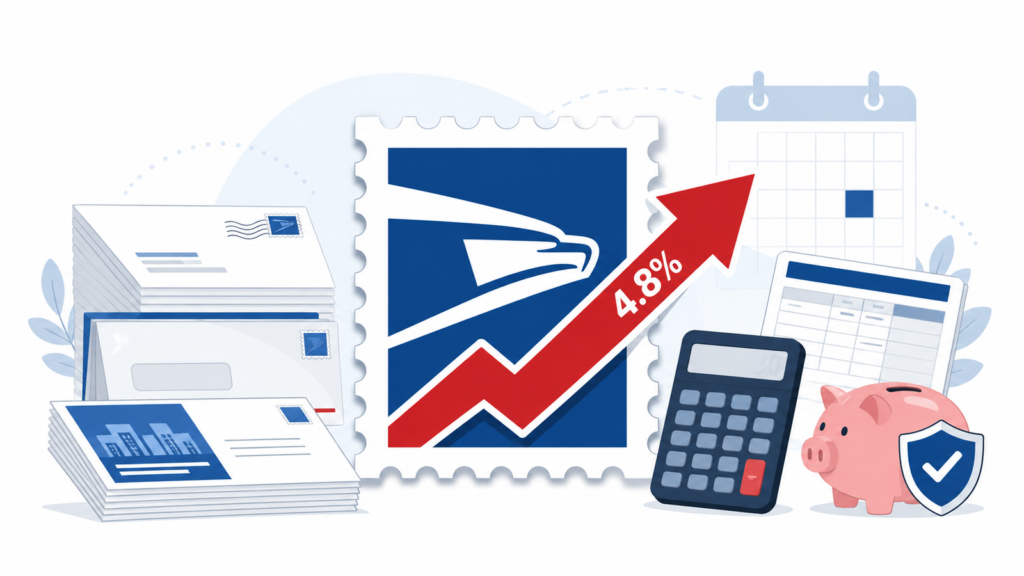
The United States Postal Service has filed a rate increase averaging 4.8% across all market-dominant mailing products, set to take effect on July 12, 2026, pending Postal Regulatory Commission approval. For businesses that rely on direct mail lists and postal marketing, this rate adjustment will directly impact campaign budgets — but the math is manageable with the right strategy.
This guide breaks down exactly what is changing, which mail classes are most affected, how the increase translates to real campaign costs, and six specific ways to offset higher postage through smarter list targeting and campaign optimization.
Q4 2026 Update (September 2026): The July rate increase has now been in effect for over two months. Early Q3 data confirms the projected 4.8% average cost impact, with First-Class metered letters seeing the sharpest year-over-year jump. Holiday campaign planners preparing Q4 mailings should build the new rates into forecasts by mid-October to lock in bulk-mail contracts before December volume peaks. The list-targeting strategies below remain the most reliable lever for offsetting the increase, and a well-segmented direct mail list can recover most of the cost impact through improved response rates.
What Is Changing on July 12, 2026
The July 2026 rate increase is the latest in a series of annual USPS adjustments authorized under the Postal Accountability and Enhancement Act. Here are the headline changes that matter most for direct mail marketers.
Forever stamp: Rising from $0.78 to $0.82 — a four-cent increase of approximately 5.1%.
First-Class Mail metered letters: Rising from $0.74 to $0.78 for one-ounce letters — a 5.4% increase. The additional-ounce surcharge is expected to hold flat at $0.29, which is good news for mailers sending heavier correspondence with multiple inserts.
Marketing Mail commercial letters: Increasing approximately 5-6% depending on presort level. Marketing Mail — formerly called Standard Mail — is the mail class used by the vast majority of direct mail advertising campaigns. This is the rate change that will hit direct marketers’ budgets most directly.
EDDM (Every Door Direct Mail): Increasing approximately 5%, but remaining the cheapest per-piece postage USPS offers for saturation mailing.
Nonprofit Marketing Mail: Increasing proportionally in the 4-5% range, though nonprofit rates remain roughly 50% lower than standard commercial Marketing Mail.
Two Structural Changes Worth Noting
Beyond the rate increases themselves, USPS is introducing two structural changes effective July 12:
New barcode fee. A $0.25 surcharge will apply to Marketing Mail parcels mailed without a valid Intelligent Mail package barcode (IMpb). If your mailing house is not already using IMpb barcodes on parcels, this fee makes it urgent to get compliant.
Combined presort minimums. Mailers will now be able to combine presorted letters with postcards to meet the 500-piece minimum for presorted Marketing Mail. Previously, each mail class had to hit the minimum independently. This is a welcome change for businesses that run mixed-format campaigns.
How the Rate Increase Translates to Campaign Costs
To understand the real-world impact, let us run the numbers on a typical direct mail campaign.
For a 50,000-piece Marketing Mail letter campaign at 5-Digit presort, the 5-6% increase translates to approximately $950-$1,100 in additional postage compared to mailing the same campaign in June 2026 at current rates.
For a 10,000-piece first-time test campaign, the increase adds roughly $190-$220 to your postage budget.
For a 100,000-piece national mailing, the additional postage cost ranges from $1,900 to $2,200.
While these numbers are real, they need to be viewed in context. Postage is only one component of total direct mail campaign cost — alongside list acquisition, printing, creative design, and fulfillment. A 5% increase on one component (postage) translates to roughly a 2-3% increase in total campaign cost for most programs.
More importantly, the response rate your direct mail list generates has a far larger impact on cost-per-acquisition than the postage rate does. A well-targeted list that produces a 3% response rate will always deliver better ROI than a cheap, untargeted list producing 0.5% — regardless of what postage costs.
Historical Context: Where Rates Have Been
The July 2026 increase of 4.8% is actually moderate by recent standards. For context, the July 2025 adjustment was 7.8%, while the July 2023 increase was 5.4% and the January 2024 increase averaged 2%. USPS rate increases have consistently outpaced general CPI inflation in recent years, reflecting the Postal Service’s operational cost pressures and declining mail volumes.
The trend is clear: annual postage increases of 4-8% are the new normal, and direct mail marketers should budget for them as a fixed line item rather than an unexpected cost. The businesses that maintain strong direct mail ROI through these increases are the ones that focus on list quality and targeting precision rather than trying to save money on postage.
6 Ways to Offset Higher Postage Costs
1. Invest in Better List Targeting
This is the single most impactful thing you can do. Higher postage makes every mail piece more expensive, which means every piece that reaches an unqualified prospect is a bigger waste of money. Tightening your targeting criteria — filtering by more precise demographics, geography, income levels, or behavioral indicators — reduces your mailing quantity while increasing your response rate.
At ProMarketing Leads, we work with clients to apply granular filters from our network of over 40,000 data sources. Whether you need consumer mailing lists filtered by income and homeownership or business mailing lists filtered by SIC code and company size, tighter targeting delivers better results per dollar spent — especially when postage costs rise.
2. Maximize Presort Discounts
The deeper your presort level, the lower your per-piece postage. The difference between Mixed AADC presort and 5-Digit presort can be $0.05-$0.06 per piece — which adds up to $2,500-$3,000 in savings on a 50,000-piece mailing. Work with a mailing house that specializes in postal optimization and can achieve the deepest presort levels your list geography allows.
3. Use Postcards for Prospecting
Postcards cost less to print and less to mail than letter packages. For prospecting campaigns where your goal is generating an initial response (a phone call, website visit, or form fill), postcards can deliver comparable response rates at significantly lower total cost per piece. Reserve full letter packages for your highest-value prospects and follow-up sequences.
4. Clean Your List Before Every Mailing
Undeliverable mail is the most expensive kind — you pay full postage for a piece that generates zero responses. Processing your list through NCOA (National Change of Address), CASS (Coding Accuracy Support System), and DPV (Delivery Point Validation) before every mailing minimizes waste. This is especially important if you are mailing a list that is more than 90 days old.
5. Coordinate Multichannel Campaigns
Instead of mailing your entire list, use direct mail strategically for your highest-value segments and supplement with lower-cost channels for the rest. Send a mail piece to your top 20,000 prospects, then reach the remaining audience via email marketing or SMS text messaging. This multichannel approach reduces your total postage spend while maintaining broad reach.
For warm leads who have already received a mail piece, follow up with telemarketing calls to close the deal. The combination of physical mail plus a personal phone call consistently produces higher conversion rates than either channel alone.
6. Time Your Mailings Strategically
If you have campaigns planned for late June or early July, moving your mail date forward to before July 12 locks in current rates. For a 50,000-piece campaign, mailing one week earlier could save you $950 or more. Beyond the immediate rate change, plan your annual mailing calendar with rate increase timing in mind — front-loading larger mailings to earlier in the year before expected July adjustments.
Why Direct Mail Still Delivers Despite Rising Postage
Despite annual rate increases, direct mail remains one of the highest-ROI marketing channels available. The reason is simple: direct mail consistently produces response rates of 2-5% for prospect lists (and 5-9% for house lists), compared to email marketing averages of 1-3% and digital display advertising click-through rates below 1%.
The tangible, physical nature of mail — the fact that someone holds it, reads it, and often keeps it — creates an engagement level that digital channels cannot replicate. For high-consideration purchases (financial services, home improvement, healthcare, insurance, real estate), that physical presence translates directly into higher conversion rates and customer lifetime value.
A 5% increase in postage does not change this fundamental math. What it does is increase the premium on list quality. The businesses that invest in well-targeted direct mail lists from a reputable list broker will continue to generate strong returns. The businesses that mail to cheap, untargeted lists will find their margins squeezed further with each rate increase.
Specialty Lists That Maximize Direct Mail ROI
When postage costs rise, mailing to the most responsive audiences becomes even more critical. These specialty list types consistently produce above-average direct mail response rates because they target people at a moment of demonstrated need:
New homeowner mailing lists — People who have just purchased a home are actively seeking home services, furniture, insurance, and financing. Response rates for new homeowner mail can be 2-3 times higher than standard compiled lists.
New mover mailing lists — People who have recently relocated need everything from local services to new doctors, dentists, and restaurants. They are actively making purchasing decisions.
Auto buyer mailing lists — Consumers with vehicles approaching lease expiration or high mileage are primed for dealership offers, aftermarket services, and extended warranty pitches.
Investor mailing lists — High-net-worth individuals identified through investment activity data respond to financial services, wealth management, and premium real estate offers at significantly higher rates.
Frequently Asked Questions
When does the USPS rate increase take effect?
The rate increase is scheduled for July 12, 2026, pending final approval by the Postal Regulatory Commission. The PRC typically approves USPS rate filings, so the July 12 date is considered highly likely.
How much is Marketing Mail postage increasing?
Marketing Mail commercial letters are increasing approximately 5-6% depending on presort level. The exact per-piece rate varies by presort tier, with 5-Digit presort letters seeing a smaller absolute increase than Mixed AADC letters. Nonprofit Marketing Mail rates are increasing proportionally in the 4-5% range.
Should I move my mailing date to before July 12?
If you have a campaign scheduled for mid-July or later, yes — mailing before July 12 locks in current rates. For a 50,000-piece campaign, this could save approximately $950-$1,100 in postage. Even if you need to accelerate your timeline by a week or two, the savings are worth the effort.
How much will this add to my direct mail campaign budget?
For a typical Marketing Mail campaign, the July 2026 rate increase adds approximately $19-$22 per thousand pieces mailed. On a 10,000-piece campaign, that is roughly $190-$220 in additional postage. The increase represents about 2-3% of total campaign cost when you factor in list, printing, creative, and fulfillment expenses.
Is direct mail still worth it with higher postage rates?
Yes. Direct mail consistently delivers response rates of 2-5% for prospecting campaigns, significantly outperforming digital channels. A 5% postage increase does not change this fundamental advantage. The key is investing in high-quality, well-targeted mailing lists so that every piece you send has the highest possible chance of generating a response.
How can I reduce the impact of the rate increase?
Six proven strategies: improve list targeting to reduce wasted mail, maximize presort discounts, use postcards for prospecting, clean your list before every mailing, supplement with lower-cost channels like email and SMS, and time your mailings to lock in pre-increase rates when possible.
Don’t Let Higher Postage Erode Your ROI
The USPS July 2026 rate increase makes one thing clear: the quality of your mailing list matters more than ever. Every piece of mail you send costs more, which means every piece that reaches the wrong person wastes more of your budget. The solution is not to mail less — it is to mail smarter.
At ProMarketing Leads, we help businesses build tightly targeted direct mail lists that maximize response rates and offset rising postage costs. Whether you need consumer lists, business lists, or specialty lists, our team can help you reach the right audience at the right time.
Contact us today for a free consultation. Call (866) 397-2772 to speak with a list expert before the July 12 rate increase.