

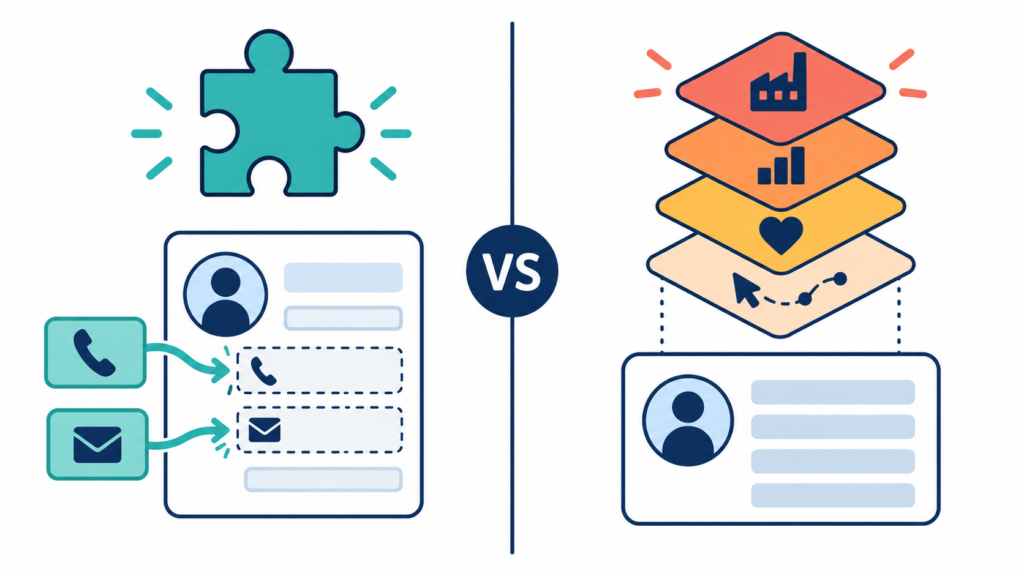
Data appending and data enrichment sound interchangeable, and most marketers use them that way. They are not the same thing. Appending fills in what is missing from your existing records — adding a phone number, email address, or mailing address that was never captured. Enrichment adds intelligence that was never there to begin with — layering firmographic, demographic, technographic, or behavioral data onto records that already have basic contact information.
The distinction matters because it determines which service you need, what results to expect, and how the improved data feeds your marketing campaigns. A business that has 20,000 customer records with names and addresses but no phone numbers needs a phone append. A business that has 20,000 records with complete contact info but no idea which ones are high-value targets needs enrichment. Many businesses need both — in a specific sequence.
What Is Data Appending?
Data appending is the process of adding missing contact fields to your existing database by matching your records against external data sources. You provide what you have (typically name and address), and the provider returns what you are missing.
The most common types of data appending include:
Phone append. Adds landline or cell phone numbers to records that have names and addresses but no phone data. Cell phone append specifically adds verified mobile numbers, enabling telemarketing and SMS outreach to contacts you could previously only reach by mail. Match rates for cell phone append typically range from 25-50% depending on data quality.
Email append. Adds email addresses to records that have names and physical addresses but no email. This unlocks email marketing as a channel for contacts in your database. Email append match rates typically run 30-50% for consumer files and 25-40% for business files.
Address append (reverse append). Adds physical mailing addresses to records that have names and email addresses or phone numbers but no postal address. This enables direct mail campaigns to contacts you could previously only reach digitally.
Address update / NCOA. Updates outdated mailing addresses using the USPS National Change of Address database. Technically a form of data correction rather than appending, but it is often bundled with append services. See our guide on mailing list hygiene for details on NCOA, CASS, and DPV processing.
The key characteristic of appending is that it fills gaps in your existing data structure. Your database already has a field for phone numbers — it is just empty on many records. Appending populates those empty fields.
What Is Data Enrichment?
Data enrichment is the process of adding entirely new categories of intelligence to your database — data points that were never part of your original data structure. Enrichment does not fill blank fields; it creates new ones.
The most common types of data enrichment include:
Demographic enrichment (consumer data). Adds personal attributes to individual consumer records: age, gender, estimated household income, home value, homeownership status, marital status, education level, presence of children, and lifestyle interests. This transforms a basic consumer mailing list into a rich profile that supports targeted segmentation and personalized messaging.
Firmographic enrichment (business data). Adds company-level attributes to business records: SIC/NAICS industry code, employee count, estimated annual revenue, years in business, ownership type, headquarters location, and number of locations. This transforms a basic business mailing list into a qualified prospect database.
Technographic enrichment. Identifies the technology platforms and software tools a company uses — CRM systems, marketing automation, e-commerce platforms, cloud infrastructure. Technographic data is primarily used by technology companies to target prospects already using compatible or competing solutions.
Behavioral and interest enrichment. Adds lifestyle interests, purchase behavior, hobby indicators, and media consumption data to consumer records. A record enriched with behavioral data might show that a homeowner is also a golfer, an avid gardener, and a frequent online shopper — enabling targeting through hobby and interest-based mailing lists.
Financial enrichment. Adds financial indicators such as estimated net worth, investment activity, and credit tier. This type of enrichment is essential for financial services firms targeting accredited investors or high-net-worth individuals.
The key characteristic of enrichment is that it adds depth and intelligence to your records, enabling better segmentation, targeting, personalization, and lead scoring. Your database may not have had a field for “household income” or “SIC code” before — enrichment adds both the field and the data.
Side-by-Side Comparison
| Attribute | Data Appending | Data Enrichment |
|---|---|---|
| What it does | Fills missing contact fields | Adds new intelligence layers |
| Common data types | Phone, email, mailing address | Demographics, firmographics, technographics, interests, financial data |
| Primary purpose | Enable new marketing channels (phone, email, mail) | Enable targeting, segmentation, personalization, lead scoring |
| Analogy | Filling in blanks on a form | Adding new pages to the form |
| Input needed | Name + at least one existing identifier (address, email, or phone) | Name + address or company name |
| Typical match rates | 25-70% depending on append type and data quality | 60-90%+ for demographic and firmographic overlays |
| Pricing model | Per record or per match | Per record or per thousand (CPM) |
| Best for | Activating multichannel campaigns | Improving targeting and campaign ROI |
When to Use Data Appending
Data appending is the right service when your primary problem is reachability — you have contacts you want to market to, but you cannot reach them through the channels you want to use.
You have addresses but need phone numbers. You want to add telemarketing or SMS as a follow-up channel to a direct mail campaign. A phone append adds the missing numbers.
You have addresses but need email. You want to supplement your postal campaigns with email marketing. An email append adds the missing addresses.
You have email but need postal addresses. You have a digital subscriber list and want to send them physical mail. A reverse append adds the mailing addresses.
You are building a multichannel campaign. You purchased a consumer mailing list with postal addresses and want to reach the same audience by phone, email, and SMS. Appending adds the missing contact points to enable coordinated multichannel outreach.
When to Use Data Enrichment
Data enrichment is the right service when your primary problem is intelligence — you can reach your contacts, but you do not know enough about them to target effectively, personalize your message, or prioritize your outreach.
You need to segment your database. You have 50,000 customer records but they are all in one undifferentiated list. Enriching with demographic or firmographic data lets you segment by income, industry, company size, or lifestyle — and tailor your messaging to each group.
You need to qualify leads. Your sales team is spending time on every lead equally. Enriching with revenue data, employee count, and title-level information lets you score and prioritize leads so reps focus on the highest-value prospects.
You need to personalize campaigns. Generic messages to a broad list produce generic results. Enriching with interests, purchase behavior, and demographic data enables the kind of segmentation and personalization that lifts response rates by 30-50%.
You are building an account-based marketing (ABM) program. ABM requires deep intelligence about each target account — industry, size, technology stack, decision-makers, and buying signals. Firmographic and technographic enrichment provides this foundation.
The Right Sequence: Clean, Append, Enrich
For most businesses, the optimal approach is not choosing between appending and enrichment — it is using both in the right sequence.
Step 1: Clean your data. Run your database through list hygiene processing — NCOA for address updates, CASS for standardization, DPV for deliverability validation, email verification, and deduplication. Cleaning first ensures that subsequent append and enrichment processes match against accurate records.
Step 2: Append missing contact fields. Add phone numbers, email addresses, or mailing addresses to records that are missing them. Appending works best on clean, current data — which is why Step 1 comes first.
Step 3: Enrich with intelligence layers. Overlay demographic, firmographic, behavioral, or financial data onto your now-complete records. Enrichment transforms your clean, multichannel-ready database into a segmented, targetable, scorable asset.
This three-step sequence — clean, append, enrich — produces a database that is accurate (clean), reachable across channels (appended), and intelligently segmented (enriched). Each step builds on the one before it.
How Data Appending and Enrichment Work Together in Practice
Here is a concrete example of how the two services combine to transform a basic customer file into a high-performing marketing asset.
Starting point: A home services company has a CRM with 30,000 customer records. Each record has a name, home address, and service history. No phone numbers, no emails, no demographic data beyond what the address tells them.
After phone append: 12,000 records (40% match) now have verified cell phone numbers. The company can add telemarketing and SMS follow-up to their direct mail campaigns.
After email append: 15,000 records (50% match) now have email addresses. The company can run email marketing campaigns to supplement postal and phone outreach.
After demographic enrichment: All 30,000 records now include estimated household income, home value, age of homeowner, and length of residence. The company can segment their database into high-value homeowners (higher income, higher home value) for premium service offers and standard homeowners for value-oriented promotions. They can target new homeowners (short length of residence) with welcome campaigns and long-term residents with maintenance reminders.
Result: The same 30,000 records that previously supported only undifferentiated direct mail now support multichannel, segmented, personalized campaigns across mail, email, phone, and SMS — with targeting precision that dramatically improves response rates and ROI.
Appending vs. Enrichment vs. Buying a New List
A common question is whether it makes more sense to append and enrich your existing database or simply purchase a new consumer or business mailing list that already includes the data you need.
Append and enrich your existing data when: Your database contains customers or prospects you have already qualified or done business with. The relationship value in your existing records is worth preserving. You want to add channels or intelligence to contacts you already own. Cost efficiency matters — appending and enriching existing records is typically cheaper per record than purchasing new multichannel data from scratch.
Buy a new list when: You need to reach an entirely new audience you have never contacted before. You are entering a new market, geographic area, or industry vertical. You need a large volume of net-new prospects with complete data from the start. Your existing database is too small, too old, or too narrow to support your campaign goals.
Do both when: You want to maximize your existing database through append and enrichment while also expanding your reach with a targeted new list purchase. This is the most common approach for businesses running ongoing direct marketing programs.
Frequently Asked Questions
What is the difference between data appending and data enrichment?
Data appending fills in missing contact fields — adding phone numbers, email addresses, or mailing addresses to records that lack them. Data enrichment adds new categories of intelligence — demographic, firmographic, technographic, or behavioral data — that were never part of your original records. Appending enables you to reach contacts through new channels. Enrichment enables you to target, segment, and personalize more effectively.
Which should I do first — appending or enrichment?
Clean your data first (NCOA, address standardization, deduplication), then append missing contact fields, then enrich with intelligence layers. Each step builds on the one before it. Appending and enriching dirty data wastes money because matches are less accurate on outdated or incorrect records.
How much does data appending cost?
Phone append typically costs $0.03-$0.15 per input record (batch) or $0.08-$0.25 per successful match. Email append pricing is similar. Costs vary by volume, data type, and provider. Contact a list broker for a custom quote.
How much does data enrichment cost?
Demographic and firmographic enrichment is typically priced per thousand records (CPM), with costs varying based on the number and type of data fields being added. Basic demographic overlays (age, income, home value) are less expensive than specialty enrichment (investment activity, technographic data). Pricing ranges widely based on scope — contact a provider for specifics.
Can I append and enrich in one step?
Some providers offer combined services that append missing contact fields and overlay enrichment data in a single pass. At ProMarketing Leads, we can handle both appending and enrichment from a single consultation, sourcing data from our network of over 40,000 providers.
Is appending the same as buying a list?
No. Appending enriches contacts you already have in your database — people you have done business with or captured through opt-in channels. Buying a list acquires entirely new contacts you have never interacted with. The compliance posture is different, and appending is generally the safer, higher-ROI approach because you are improving assets you already have a basis to contact.
Get More from Your Existing Data
Whether you need to append missing phone numbers and emails or enrich your database with demographic and firmographic intelligence, ProMarketing Leads can help. Our phone append and data enrichment services draw from our network of over 40,000 verified data sources — transforming your existing records into multichannel, segmented, campaign-ready assets.
Contact us today for a free consultation. Call (866) 397-2772 to speak with a data expert.