

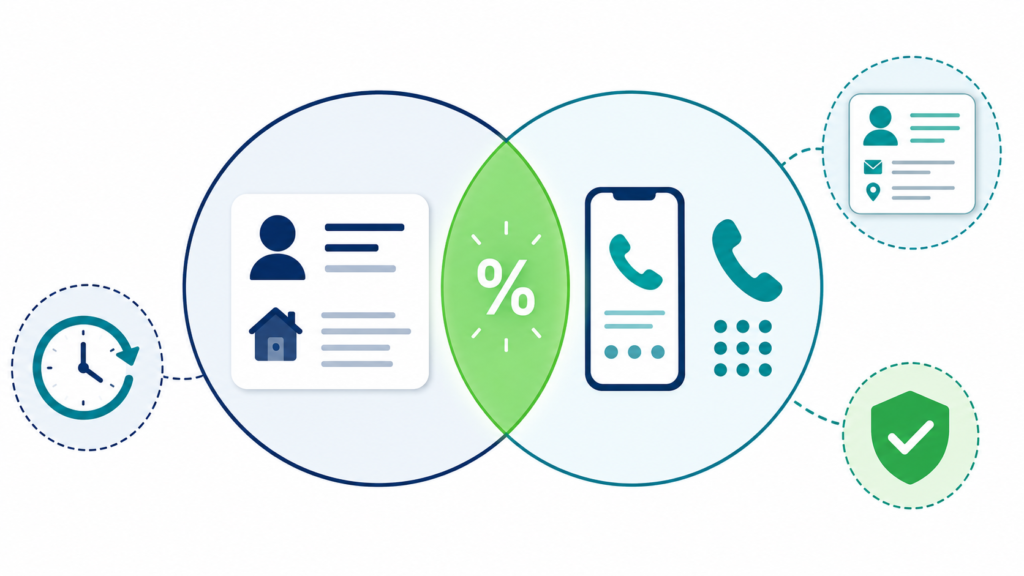
A cell phone append match rate is the percentage of records in your input file that are successfully matched to a verified phone number during the appending process. If you submit 10,000 customer records and 3,500 come back with appended cell phone numbers, your match rate is 35%. Understanding what match rates to expect — and what you can do to improve them — prevents disappointment and helps you budget accurately for your phone append project.
Match rates are the single most common question businesses ask when evaluating a phone append service, and the answer is not a single number. Rates vary significantly based on the type of phone number being appended, the quality of your input data, the age of your records, and the databases your provider matches against.
Phone Append Match Rate Benchmarks
Industry benchmarks vary by phone type and data source. Here are the realistic ranges based on current provider data and industry experience:
Cell phone only append: 25-40% is the typical range for a standard consumer or business file. Cell numbers are harder to match than landlines because they are not published in public directories, change hands more frequently, and are often associated with individuals rather than addresses. High-quality consumer files with complete name, address, and date of birth can push cell-only match rates to 50-70% with premium data sources.
Landline append: 35-50% is typical. Landline numbers are easier to match because many are listed in public telephone directories and have historically been tied to physical addresses. However, landline match rates have been declining as more households cut the cord — approximately 72% of U.S. adults now live in wireless-only households according to the CDC’s National Health Interview Survey.
Combined phone append (cell + landline): 45-70% when the provider returns the best available number regardless of type. Combined appends produce the highest match rates because the provider draws from both cell and landline databases.
Business phone append: 40-65% for direct-dial numbers to specific contacts. General company switchboard numbers match at higher rates (60-80%) but are less valuable for outreach because they do not reach the decision-maker directly. Business mailing list files with verified contact names produce significantly higher match rates than company-name-only files.
Business owner cell phone append: 30-50% is typical for matching business owners to their personal mobile numbers. This is a specialized append type that requires matching the individual owner — not the business — against consumer phone databases. Business owner cell phone append is in high demand because reaching the owner directly on their mobile bypasses gatekeepers and voicemail trees.
Why Match Rates Vary So Much
The gap between a 25% match rate and a 70% match rate on the same file type comes down to six factors. Understanding each one helps you set realistic expectations and take steps to maximize your results.
1. Input Data Quality
This is the single largest factor affecting match rates. Phone appending works by matching your records against phone databases using identifying information — typically name and address, and sometimes date of birth or email address. The more complete and accurate your input data, the more records the matching algorithm can confidently link to a phone number.
High-quality input: Full name (first and last), current mailing address with correct ZIP+4, date of birth or age. These files match at the top of the range.
Low-quality input: Incomplete names (first name only, nickname), outdated addresses, missing ZIP codes, misspelled street names. These files match at the bottom of the range — and the matches that do come back may be less reliable.
2. Data Recency
How old is your file? A customer database that has not been updated in three years contains addresses where people no longer live, names associated with previous residents, and demographic data that no longer matches the current occupant. Older files produce lower match rates because the matching algorithm cannot find the person at the address you provided.
Running your file through NCOA processing before appending — updating addresses for people who have moved — significantly improves match rates by ensuring the name-and-address pairs in your file are current.
3. Phone Type Requested
Cell-only appends produce lower match rates than combined appends because cell numbers are not publicly listed. If your use case allows it (for example, if you need phone numbers for telemarketing rather than SMS marketing), requesting a combined append that returns either cell or landline will maximize your match rate.
If you specifically need cell numbers for SMS campaigns, the cell-only match rate is what matters — and you should budget accordingly. A 30% cell-only match on 50,000 records gives you 15,000 SMS-reachable contacts.
4. Consumer vs. Business Data
Consumer files generally produce higher overall match rates than business files because consumer phone databases are larger and draw from more diverse sources (credit headers, public records, surveys, purchase data). Business phone data — particularly direct-dial and cell numbers for specific individuals — requires matching against a more limited set of commercial databases.
5. Geographic Coverage
Phone database coverage varies by region. Urban and suburban areas typically produce higher match rates than rural areas due to denser data coverage. Certain states with stricter privacy regulations may also have lower match rates for specific data types.
6. Provider Database Depth
Not all append providers match against the same databases. Providers who aggregate data from multiple independent sources — carrier records, credit bureaus, public records, survey data, and commercial data compilers — produce higher match rates than providers relying on a single data source. At ProMarketing Leads, we match against multiple verified carrier and consumer databases to maximize match rates across every file type.
6 Ways to Improve Your Phone Append Match Rate
1. Clean Your File Before Appending
Run your input file through NCOA, CASS, and DPV processing before submitting it for phone appending. This updates addresses for people who have moved, standardizes address formatting, and removes undeliverable addresses. Clean addresses match at significantly higher rates than outdated or malformatted ones.
2. Include Complete Name and Address Fields
Ensure every record has a full first name, full last name, complete street address, city, state, and ZIP code. Records missing any of these fields are much harder to match. If your database uses abbreviations or nicknames (Bill instead of William, Bob instead of Robert), consider expanding them to formal names — matching algorithms perform better against legal names.
3. Add Date of Birth Where Available
Date of birth is the strongest secondary matching field after name and address. It resolves ambiguity when multiple people share the same name — John Smith at 123 Main Street is not uniquely identifiable, but John Smith born 03/15/1978 at 123 Main Street almost certainly is. If your database contains DOB data, include it in your append file.
4. Request a Test Batch First
Before committing your full file, run a test batch of 1,000-5,000 records. This gives you an accurate preview of the match rate, data quality, and line-type distribution you can expect from the full run. Most reputable providers, including ProMarketing Leads, offer free test appends so you can evaluate results before purchasing.
5. Use Multiple Append Passes
Records that do not match on the first pass may match if you try a different approach. Some providers offer secondary matching algorithms that use looser criteria (first name and ZIP code only, for example) to capture additional matches that the primary algorithm missed. These secondary matches may have slightly lower confidence scores but can add 5-15% to your overall match rate.
6. Append Regularly, Not Once
Phone databases are updated continuously as new numbers are activated, old numbers are disconnected, and carriers reassign numbers. Running your file through an append process every 6-12 months captures numbers that were not in the database during your previous append. Records that failed to match six months ago may match today because the consumer’s phone data has been newly captured.
What to Do with Unmatched Records
Even a strong append leaves 30-60% of your records without a phone number. These unmatched records are not useless — they still have value through other channels.
Direct mail: Records with valid mailing addresses can still be reached through direct mail campaigns. In fact, direct mail to addresses where you could not append a phone number is often the best way to generate initial engagement that you can then convert to a phone or SMS relationship.
Email append: If your unmatched records have names and addresses but no phone numbers or email addresses, an email append may successfully match a portion of them to email addresses — giving you a digital contact point even without a phone number.
Future re-append: Hold unmatched records and re-submit them in 6-12 months. Phone databases are continuously updated, and records that did not match today may match on a future pass.
Match Rate vs. Connect Rate: Know the Difference
Match rate measures how many records received a phone number through the append process. Connect rate measures how many of those appended numbers actually reach a live person when you call or text them.
A high match rate with a low connect rate means the appended numbers are outdated, disconnected, or incorrectly matched. A quality provider validates every appended number for active carrier status and flags disconnected, reassigned, and VoIP numbers before delivery. Industry-leading providers guarantee connect rates of 90-95% on appended numbers.
When evaluating providers, ask about both match rate and connect rate. A provider who delivers a 60% match rate with 95% connect rates is more valuable than one who delivers a 75% match rate with 70% connect rates — because the first provider delivers more usable, contactable numbers.
TCPA Compliance for Appended Phone Numbers
Appending a cell phone number to a customer record does not automatically grant you permission to send marketing texts or robocalls to that number. TCPA compliance still applies.
For telemarketing calls using a live agent (no autodialer), you can call appended numbers that are not on the National DNC Registry, or numbers where you have an existing business relationship.
For SMS marketing or autodialed calls, you need prior express written consent — which a phone append does not provide. Appended cell numbers can be used for manual-dial outreach and then converted to SMS-consented contacts through proper opt-in procedures during the conversation.
Always scrub appended numbers against the National DNC Registry before any outreach campaign.
Frequently Asked Questions
What is a good phone append match rate?
Match rates vary by phone type and data quality. Cell-only append typically matches 25-40% of records. Combined cell and landline append matches 45-70%. Business phone append matches 40-65% for direct dials. A match rate above 50% on a combined append is generally considered strong.
Why is my cell phone append match rate lower than expected?
Common causes include outdated addresses in your input file, incomplete name fields, requesting cell-only numbers (which match at lower rates than combined), and poor data quality overall. Clean your file through NCOA processing and ensure all name and address fields are complete before resubmitting.
How can I improve my match rate?
Six strategies: clean your file through NCOA/CASS before appending, include complete name and address fields, add date of birth where available, request a test batch first, use multiple append passes, and re-append every 6-12 months to capture newly available numbers.
What is the difference between match rate and connect rate?
Match rate is the percentage of input records that receive an appended phone number. Connect rate is the percentage of those appended numbers that actually reach a live person. A quality provider validates numbers for active carrier status and guarantees connect rates of 90-95%.
Can I use appended phone numbers for SMS marketing?
Appending a number does not provide TCPA consent for marketing texts. Appended cell numbers can be used for manual-dial telemarketing outreach (compliant with DNC rules), and then converted to SMS-consented contacts through proper opt-in procedures during the conversation.
How much does phone appending cost?
Cell phone append typically costs $0.03-$0.15 per input record for batch processing, or $0.08-$0.25 per successful match. Landline append costs $0.02-$0.08 per input record. Business phone append costs $0.05-$0.20 per input record. Most providers offer free test batches before you commit.
Get the Highest Match Rate for Your File
Match rates depend on your data quality and your provider’s database depth. At ProMarketing Leads, our phone append service matches against multiple verified carrier and consumer databases to maximize match rates — and every appended number is validated for active status, classified by line type, and DNC-scrubbed before delivery.
Contact us today for a free test append and custom quote. Call (866) 397-2772 to speak with a data expert.