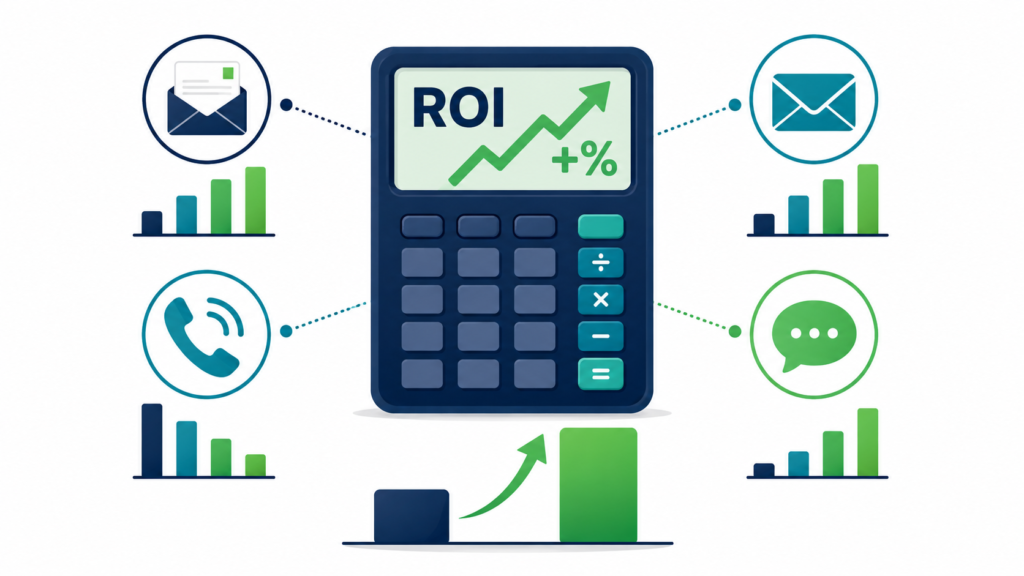
Direct marketing ROI measures the revenue your campaign generates relative to what it costs to execute. It is the definitive metric for determining whether a campaign was worth the investment — and it is the number that should drive every decision about which channels, lists, and offers to use.
According to the 2025 ANA/DMA Response Rate Report — the most current industry benchmark — direct mail to house lists averages 161% ROI, the highest of any paid marketing channel measured. But ROI varies dramatically by channel, list quality, offer, and execution. Understanding how to calculate ROI accurately, how to benchmark it against industry standards, and how to systematically improve it is what separates profitable direct marketing programs from unprofitable ones.
The ROI Formula
The basic direct marketing ROI formula is straightforward:
ROI = ((Revenue – Total Campaign Cost) / Total Campaign Cost) x 100
For example, if a campaign costs $15,000 to execute and generates $45,000 in revenue, the ROI is ((45,000 – 15,000) / 15,000) x 100 = 200%.
Total campaign cost should include every expense involved in executing the campaign: list acquisition (the cost of your consumer mailing list or business mailing list), creative development (design, copywriting, photography), production (printing for mail, HTML coding for email), distribution (postage for mail, platform fees for email/SMS), and fulfillment (response handling, lead processing, call center costs).
Revenue should include only revenue that is directly attributable to the campaign — tracked through unique phone numbers, personalized URLs, promotional codes, or other campaign-specific identifiers.
Response Rate Benchmarks by Channel
Response rate is the input that feeds the ROI calculation. Here are the current benchmarks from the 2025 ANA/DMA Response Rate Report and supporting industry research:
Direct Mail
The average direct mail response rate is 4.4% across all list types and formats — the highest response rate of any paid marketing channel. Breaking it down by list type tells a more actionable story:
House lists (existing customers and known contacts): 5-9% average response rate. These contacts know your brand and have a relationship with your business, which drives significantly higher engagement.
Prospect lists (cold audience from purchased data): 2-4.4% average response rate. These contacts have no prior relationship with your brand, so the list quality, offer, and creative must do the heavy lifting.
Response rates also vary by industry. According to the ANA 2025 report, healthcare campaigns average 4.09%, financial services average 3.95%, and automotive campaigns average 3.84%.
Email Marketing
Email metrics must be interpreted carefully because they measure different actions than direct mail. Industry averages from Mailchimp’s benchmark data show approximately 21.5% open rates across industries and approximately 2.6% click-through rates. At the direct-response level — measuring actual conversions rather than just clicks — email averages 0.12% according to ANA data.
The gap between email’s click-through rate (2.6%) and direct-response rate (0.12%) reflects the difference between casual engagement (clicking a link) and committed action (making a purchase, calling a number, filling out a form). This distinction matters when comparing email ROI to direct mail ROI, because a direct mail “response” typically represents a higher-intent action than an email “click.”
Telemarketing
Telemarketing response rates vary widely based on whether calls are cold outreach (1-3% appointment set rate) or warm follow-ups to previous touchpoints (8-15% conversion rate). The strength of telemarketing lies not in raw response volume but in lead quality — a phone conversation allows real-time qualification, objection handling, and relationship building that no other channel can replicate.
SMS Marketing
SMS marketing achieves open rates of approximately 98% and click-through rates of 15-30% when a link is included. Conversion rates for SMS campaigns typically range from 1-3% for cold outreach and 5-10% for campaigns to existing customers. SMS’s strength is immediacy — messages are typically read within 3 minutes of delivery. All SMS marketing requires strict TCPA compliance.
How to Calculate Direct Mail Campaign ROI: A Worked Example
Let us walk through a real-world ROI calculation for a direct mail campaign using a purchased consumer mailing list.
Campaign parameters:
- List: 25,000 records of homeowners in a target market at $100 CPM = $2,500
- Creative design and copywriting: $1,500
- Printing (postcard format): $0.25 per piece = $6,250
- Postage (Marketing Mail presort): $0.35 per piece = $8,750
- Total campaign cost: $19,000
Results:
- Response rate: 3% = 750 responses
- Conversion rate (response to sale): 20% = 150 new customers
- Average customer value (first purchase + 12-month value): $300
- Total revenue: 150 x $300 = $45,000
ROI = ((45,000 – 19,000) / 19,000) x 100 = 136.8%
This campaign returned $2.37 for every $1 invested. The key variables that most influence this outcome are the response rate (driven by list quality and targeting), the conversion rate (driven by offer strength and follow-up process), and customer value (driven by product pricing and retention).
How to Calculate Email Campaign ROI: A Worked Example
Campaign parameters:
- List: 50,000 email addresses at $50 CPM = $2,500
- Email platform and sending: $200
- Creative (template design, copy): $500
- Total campaign cost: $3,200
Results:
- Open rate: 15% = 7,500 opens
- Click-through rate: 2.5% = 1,250 clicks
- Conversion rate (click to sale): 5% = 62 new customers
- Average customer value: $150
- Total revenue: 62 x $150 = $9,300
ROI = ((9,300 – 3,200) / 3,200) x 100 = 190.6%
This email campaign returned $2.91 for every $1 invested — a higher ROI percentage than the direct mail example above. But notice the total profit: email generated $6,100 in profit from 50,000 contacts, while direct mail generated $26,000 in profit from 25,000 contacts. This illustrates why ROI percentage alone does not tell the full story — total profit and profit per contact matter equally.
6 Strategies to Improve Your Direct Marketing ROI
1. Invest in Better List Targeting
List quality has a larger impact on ROI than any other variable. A well-targeted list of 10,000 prospects who closely match your ideal customer profile will outperform a generic list of 50,000 every time. Work with your list broker to apply the deepest available targeting filters — narrowing by demographics, firmographics, geography, behavior, and life events — so every contact on your list has a genuine probability of responding.
2. Coordinate Multichannel Campaigns
Industry research shows that multichannel campaigns combining direct mail with digital follow-up produce 27-118% higher response rates than single-channel campaigns on the same audience. A coordinated sequence of mail, then email, then phone creates multiple touchpoints that reinforce your message and accelerate conversion. The incremental cost of adding digital channels is modest compared to the response rate lift.
3. Test and Iterate Systematically
Never roll out a campaign at full scale without testing. Start with a test cell of 5,000-10,000 records and measure response rates before committing your full budget. Test one variable at a time — list segment, offer, format, creative, or call to action — so you can isolate what drives improvement. Accumulate learnings across campaigns and apply them to continuously optimize performance.
4. Maintain List Hygiene
Every undeliverable piece of mail or bounced email is wasted budget that drags down your ROI. Process postal data through NCOA, CASS, and DPV before every mailing. Verify email addresses before every send. Scrub phone lists against the DNC registry. Clean data does not just reduce waste — it also improves response rates because it ensures your message reaches real, current contacts.
5. Track and Attribute Accurately
You cannot improve what you cannot measure. Assign unique tracking identifiers to every campaign and every list segment — dedicated phone numbers, personalized URLs, unique promo codes, and QR codes. Track responses by segment to identify which targeting criteria, offers, and creative approaches produce the best ROI. Without accurate attribution, your optimization decisions are based on guesswork rather than data.
6. Optimize Customer Lifetime Value
ROI calculations based only on the first purchase understate the true value of direct marketing. A customer acquired through a direct mail campaign who makes repeat purchases over 12-24 months may deliver 3-5x the revenue attributed to the initial campaign response. Factor customer lifetime value (CLV) into your ROI calculations to get the true picture — and to justify higher upfront spending on quality lists and multichannel campaigns that acquire higher-value customers.
Frequently Asked Questions
What is a good ROI for direct marketing?
Industry benchmarks vary by channel and list type. Direct mail to house lists averages 161% ROI according to the ANA 2025 report. For prospect campaigns, ROI of 50-150% is generally considered strong. The key variables are list quality, offer relevance, and customer lifetime value.
How do I calculate direct marketing ROI?
ROI = ((Revenue – Total Campaign Cost) / Total Campaign Cost) x 100. Total cost includes list, creative, production, distribution, and fulfillment. Revenue includes only campaign-attributable sales tracked through unique identifiers.
Which channel has the highest direct marketing ROI?
According to the ANA 2025 Response Rate Report, direct mail to house lists produces the highest ROI of any paid channel at 161%. However, email can produce competitive or superior ROI percentages for lower-ticket products due to its dramatically lower per-contact cost. The highest overall ROI comes from multichannel campaigns combining mail, email, phone, and SMS.
What is the average direct mail response rate?
The average direct mail response rate is 4.4% across all list types according to the ANA/DMA 2025 report. House lists average 5-9% and prospect lists average 2-4.4%. Response rates vary by industry, format, and offer.
How do I improve my direct marketing ROI?
Six proven strategies: invest in better list targeting, coordinate multichannel campaigns, test and iterate systematically, maintain list hygiene, track and attribute accurately, and factor customer lifetime value into your calculations.
Does direct mail or email have better ROI?
It depends on your product value and sales cycle. Direct mail produces higher response rates and higher total profit per contact, making it superior for high-ticket products. Email produces higher ROI percentages due to lower costs, making it superior for low-ticket, high-frequency campaigns. The best results come from using both together.
Maximize the Return on Every Marketing Dollar
ROI starts with the list. At ProMarketing Leads, we help businesses build precisely targeted direct mail lists, email lists, telemarketing lists, and SMS lists that maximize response rates and campaign ROI — sourced from our network of over 40,000 verified data providers with one-on-one consultation on every order.
Contact us today for a free consultation and custom quote. Call (866) 397-2772 to speak with a list expert.