The quality of your mailing list is the single largest factor in determining whether a direct marketing campaign succeeds or fails. Industry research consistently attributes roughly 40% of a campaign’s performance to the list — more than the offer (30%) or the creative (30%). Yet many businesses choose their list provider based on price alone, which is the fastest path to wasted budget and poor results.
Not all mailing list providers are created equal. Data sourcing practices, accuracy standards, update frequency, compliance infrastructure, and support quality vary widely across the industry. Asking the right questions before you buy separates a provider who will deliver results from one who will deliver headaches.
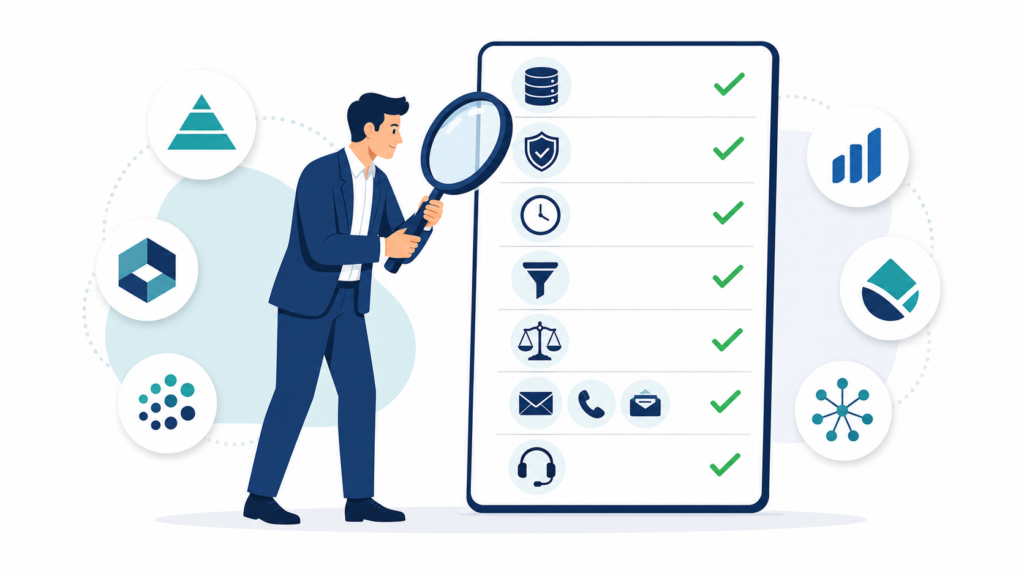
Here are seven questions every marketer should ask before purchasing a consumer mailing list, business mailing list, or any other marketing data.
Question 1: Where Does Your Data Come From?
Data sourcing transparency is the most important indicator of list quality. A reputable provider will explain exactly where their data originates and how it is compiled or aggregated.
High-quality consumer data is sourced from property deed records, vehicle registrations, voter files, census data, survey responses, purchase transaction records, subscription registrations, and other verified public and proprietary sources. High-quality business data comes from business registrations, professional license databases, corporate filings, trade directories, and verified business data aggregators.
Red flag: If a provider cannot or will not explain where their data comes from, walk away. Vague answers like “proprietary sources” or “our database” without specifics suggest the data may be scraped, recycled, or compiled from low-quality origins. Providers who rely on scraped or unverified data deliver lower accuracy, higher bounce rates, and potential compliance exposure.
What to look for: A provider who names specific data source categories, explains how records are collected and verified, and can describe their data supply chain in detail. The best providers — including full-service list brokers — maintain relationships with multiple vetted data partners and can source from thousands of independent databases rather than relying on a single proprietary file.
Question 2: How Accurate Is Your Data, and How Do You Verify It?
Accuracy is the difference between a campaign that generates a 3% response rate and one that generates 0.5%. Every inaccurate record on your list is money wasted on printing, postage, or digital delivery to a contact that does not exist, has moved, or is no longer relevant.
For postal data, ask whether the provider processes their files through NCOA (National Change of Address), CASS (Coding Accuracy Support System), and DPV (Delivery Point Validation). These are USPS-maintained systems that verify addresses are current, properly formatted, and actually deliverable. Best-practice providers who run all three achieve deliverability rates of 95-98% on postal data.
For email data, ask how email addresses are verified. Quality providers use email verification tools that check for invalid addresses, abandoned mailboxes, spam traps, role-based addresses (info@, sales@), and disposable email domains. Deliverability guarantees for well-maintained email lists typically range from 85-95%.
For phone data, ask whether numbers are verified for active status, carrier type (mobile vs. landline), and reassignment history. This is especially important for SMS marketing lists and telemarketing lists, where contacting a reassigned number creates TCPA liability.
Red flag: A provider who cannot provide specific accuracy metrics or deliverability guarantees. If they say “our data is very accurate” but cannot back it up with numbers, their verification processes are likely inadequate.
Question 3: How Often Is Your Data Updated?
Marketing data degrades faster than most businesses realize. People move — the USPS processes approximately 35-40 million address changes per year. People change jobs — industry estimates indicate that roughly 30% of B2B contact data becomes inaccurate within a single year due to job changes, promotions, and company turnover. Phone numbers are reassigned, email addresses are abandoned, and businesses open and close.
What to look for: Monthly data refreshes are the gold standard. For postal data, monthly NCOA processing ensures address changes are captured promptly. For business data, monthly verification of job titles, phone numbers, and email addresses minimizes the decay problem. For specialty lists like new homeowner mailing lists and new mover lists, weekly or biweekly updates are ideal because these lists are inherently time-sensitive — the value of reaching a new homeowner decreases with every week that passes after their purchase.
Red flag: Providers who update quarterly, semiannually, or cannot specify their update cycle. A six-month-old list of business contacts could have 15% or more of its records already outdated. A year-old list could be 30% inaccurate — meaning nearly one in three records is wasted spend.
Question 4: How Deep Is Your Targeting and Customization?
The power of a purchased mailing list lies in its ability to narrow a large universe down to only the most relevant prospects. The more granular the available targeting filters, the more precisely you can match your list to your ideal customer profile.
For consumer lists, a quality provider should offer filters including geographic area (ZIP code, city, county, radius), age, gender, household income, home value, homeownership status, marital status, education level, interests and hobbies, purchase behavior, and life-event triggers. The best providers also offer specialty segments like investor leads, auto buyer lists, ethnic mailing lists, and ailment-targeted lists.
For business lists, look for SIC or NAICS industry code targeting, company size (employee count and revenue), geographic location, specific job titles, functional departments, years in business, ownership type, and technology usage data. Specialty segments include medical professional lists, nurse mailing lists, real estate professional lists, and new business lists.
Red flag: Providers who only offer basic geographic and broad demographic filters. If you cannot filter by specific job title, income range, or behavioral indicator, the provider’s data is likely too shallow to support targeted campaigns.
Question 5: What Is Your Compliance Infrastructure?
Data regulations are complex, channel-specific, and carry severe penalties for violations. Your list provider’s compliance practices directly affect your legal exposure.
For email data, the provider should explain how their data collection practices comply with the CAN-SPAM Act. While CAN-SPAM does not require prior opt-in consent for commercial email in the U.S., the data should be sourced from legitimate origins — not scraped from websites or harvested from social media profiles.
For phone and SMS data, compliance requirements are significantly stricter. The TCPA requires prior express written consent for marketing text messages, and telemarketing calls must comply with DNC registry requirements. Ask your provider specifically how their phone data is collected, whether consent documentation is available, and whether lists are scrubbed against the National DNC Registry before delivery.
For international data, ask about compliance with GDPR (European Union), CASL (Canada), and other regional privacy regulations. International mailing lists require providers who understand and comply with cross-border data requirements.
Red flag: A provider who is vague about compliance or says “compliance is the buyer’s responsibility.” While the marketer does bear ultimate responsibility for campaign compliance, a quality provider actively supports compliance by sourcing data properly, providing documentation, and performing required suppression processing (DNC scrubbing, opt-out management) before delivery.
Question 6: Do You Support Multichannel Data?
Modern direct marketing campaigns rarely rely on a single channel. The most effective campaigns coordinate direct mail, email, telemarketing, and SMS to create multiple touchpoints with the same audience.
Ask whether your provider can supply multichannel data — physical mailing addresses, email addresses, and phone numbers — for the same audience. Having all three data types from a single source ensures consistency across channels and simplifies campaign coordination.
Also ask about data enrichment capabilities. If you already have a customer database with mailing addresses, can the provider append missing phone numbers through a phone append service? Can they add email addresses? Can they overlay demographic or firmographic data to enable better segmentation? A provider with enrichment capabilities adds value beyond just selling you a new list.
Red flag: Providers who only offer one data type (postal only, or email only) and cannot source multichannel data. Single-channel providers limit your campaign options and force you to manage multiple vendor relationships for one audience.
Question 7: What Kind of Support Do You Provide?
The difference between a list vendor and a list partner is the quality of support they provide before, during, and after your purchase.
Before purchase: Does the provider take a consultative approach — asking about your business, your campaign goals, your ideal customer, and your budget — or do they simply process an order? A consultative provider will recommend targeting strategies you may not have considered, suggest data sources that match your specific needs, and help you avoid common list-buying mistakes.
During fulfillment: Can the provider deliver a record count based on your criteria before you commit? Will they provide sample records so you can preview data quality and field completeness? Do they deliver data in whatever format your systems require — CSV, Excel, tab-delimited, or direct CRM integration?
After delivery: Does the provider follow up to help you analyze campaign results? Will they help you refine your targeting for subsequent campaigns based on what you learned? A provider who cares about your results will want to know how the list performed and help you improve next time.
Red flag: Providers who offer no consultation, no record counts, no samples, and no post-campaign support. If a provider treats every order as a transaction rather than a relationship, they are not invested in your success.
Pricing: What to Expect and How to Evaluate
Mailing list pricing is typically structured on a cost-per-thousand (CPM) basis. General ranges based on industry standards:
Consumer mailing lists typically range from $40 to $150 per thousand records, depending on the depth of targeting selects and whether the list is compiled or response-based. Basic geographic and demographic selects are usually included in the base price, while deeper behavioral, financial, or lifestyle filters may carry a small additional surcharge.
Business mailing lists cost more per record than consumer lists — typically $75 to $250+ per thousand — because B2B data requires ongoing verification of individual contacts, titles, and direct-dial numbers.
Specialty lists — including medical professional lists, investor lists, and real estate leads — command premium pricing due to the additional verification and niche targeting involved.
The key principle: do not choose a provider based on the lowest price per record. A cheap list that is 80% deliverable and poorly targeted will cost you more in wasted postage, printing, and missed opportunities than a higher-quality list that is 97% deliverable and precisely targeted. Evaluate price in the context of data quality, accuracy guarantees, and expected response rates — not in isolation.
Frequently Asked Questions
What is the most important factor in choosing a mailing list provider?
Data accuracy is the most important factor. A list with 97% deliverability and precise targeting will produce dramatically better campaign results than a cheaper list with 80% deliverability and broad targeting. Ask for specific accuracy metrics and deliverability guarantees before purchasing.
How much do mailing lists cost?
Consumer mailing lists typically range from $40 to $150 per thousand records (CPM). Business mailing lists range from $75 to $250+ per thousand due to the additional contact-level verification required. Specialty lists (medical, investor, real estate) command premium pricing. All pricing varies based on targeting depth, volume, and usage rights.
Should I use a list broker or buy directly from a data compiler?
A list broker provides access to thousands of independent data sources and can shop the market on your behalf. A data compiler maintains a single proprietary database. For most campaigns, a broker offers more flexibility, deeper targeting options, and the ability to blend data from multiple sources for the best results. For a detailed explanation, see our guide on what a list broker is and how they work.
Can I test a mailing list before buying a large quantity?
Yes. Most reputable providers allow you to order a test quantity of 5,000 to 10,000 records to validate list quality and campaign performance before scaling up. Some providers also offer sample records so you can preview data quality and field completeness before placing any order.
What format will my mailing list come in?
Standard delivery formats include CSV, Excel, and tab-delimited files compatible with CRM systems and mailing house requirements. Some providers also offer direct API integration or mailing-house-ready presorted files. Ask about format options before purchasing.
How do I know if a mailing list provider is reputable?
Look for data sourcing transparency, specific accuracy guarantees, documented compliance practices, a consultative sales process, and willingness to provide record counts and samples before purchase. Reputable providers welcome questions about their data and processes. Providers who are evasive about sourcing, compliance, or accuracy should be avoided.
Find the Right List Provider for Your Next Campaign
The right mailing list provider does more than sell you data — they consult with you on targeting strategy, deliver verified and compliant records, and help you maximize campaign ROI. At ProMarketing Leads, we have been connecting businesses with targeted marketing data since 2005 — sourcing consumer lists, business lists, and specialty lists from our network of over 40,000 verified data sources with one-on-one consultation on every order.
Contact us today for a free consultation and custom quote. Call (866) 397-2772 to speak with a list expert.